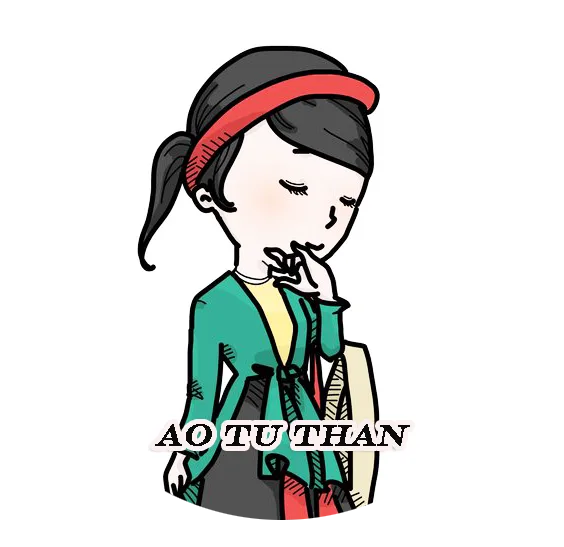
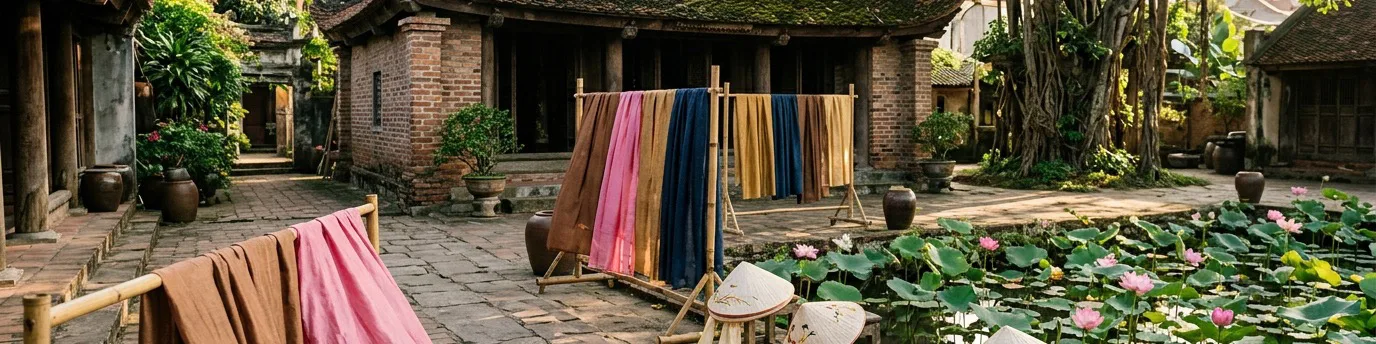
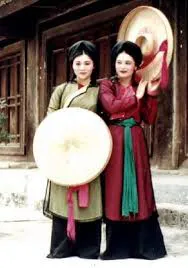
To understand the complete traditional wardrobe of Northern Vietnamese women, one must look at the harmonious ensemble built around the Ao Tu Than: starting from the inner Yem bodice and silk waistband, layered beneath the four-panel tunic, paired with a dark flowing skirt or trousers, a crow's-beak kerchief (Khan Mo Qua), and completed by the broad flat palm hat (Non Quai Thao) worn alongside a swaying "rooster-tail" hair tuft (toc duoi ga).
Historical Descriptions in Literature and Cultural Scholarship
In his classic ethnographic work Vietnamese Customs (Viet Nam Phong Tuc), the early twentieth-century scholar Phan Ke Binh recorded how women in the Northern Red River Delta dressed in daily and festive life, offering a vivid window into the history of the Ao Tu Than in Vietnam:
"Women coil their hair inside a cloth tube made of dark indigo fabric, black gauze, crêpe, or brown cloth. In cold weather, they drape an additional square kerchief of black or dark brown cloth folded diagonally over the head. Their Yem bodice features a round or V-shaped collar, most commonly sewn from plain white cloth for daily work. The Ao Tu Than is likewise tailored in dark or earthy brown hues for everyday wear; only during village festivals or among professional singers do women wear bright red and green tunics. Their skirts or trousers are woven from raw silk or glossy black satin, though festive red crêpe is occasionally worn."
This same iconic ensemble—combining the embroidered Yem bodice, silk waistband, Ao Tu Than tunic, crow's-beak kerchief, black silk trousers, and Non Quai Thao hat paired with a high rooster-tail hair wrap—was immortalized by poet Nguyen Nhuoc Phap in his beloved poem "Perfume Pagoda" (Chua Huong), which captures the rustic country soul embodied in the Ao Tu Than:
- "Small kerchief, high rooster-tail hair,"
- "Wearing an embroidered crimson Yem bodice,"
- "New silk trousers and freshly tailored tunic,"
- "Holding a flat Non Quai Thao hat in her hand."
Throughout this multi-part series in our traditional costume characteristics archive, we examine each component that formed the complete, socially recognized dress code of women in the Northern delta of old—including kerchiefs, hats, Yem bodices, four-part tunics, silk belts, skirts, and curved slippers.
The Art of the Hair Coil (Khan Van) and Crow's-Beak Kerchief (Khan Mo Qua)
Traditionally, Vietnamese women cultivated long, lustrous black hair. To keep their hair neat during agricultural labor and village gatherings, they practiced the art of van toc—coiling the hair inside a cylindrical cloth tube called a khan van. Made from black cotton, crêpe (nhieu), or velvet (though velvet required careful pinning because it slipped more easily than textured crêpe), this hair wrap became an inseparable companion to the Ao Tu Than across different historical periods.
Wrapping long hair smoothly into the fabric tube required deft hands, coiling the cloth several turns around the crown while leaving a graceful tuft of hair protruding at the end, known as the toc duoi ga ("rooster tail"). Perched neatly on the side or back of the head, this glossy hair end swayed gently in rhythm with the woman's steps; women whose natural hair was not sufficiently long or thick often braided in a supplemental hairpiece (toc don) to achieve the proper fullness.
Over the coiled hair tube, women tied an outer square kerchief—worn as a Khan Mo Qua (crow's-beak kerchief) during cool autumn and winter days, or tied horizontally during the warm summer months. Tying the crow's-beak kerchief demanded a refined eye for proportion so that the cloth flattered the wearer's features: if tied too high on the forehead, the peak looked stiff and exaggerated; if pulled too low, the dark fold cast a heavy shadow across the eyes. When folded with skill, the pointed "crow's beak" rested gently at the center part of the brow while the two sides curved like a crescent moon around the cheeks, making a young woman's fair, rosy complexion glow like a pink lotus bud against the deep black fabric.
To achieve a flawless Khan Mo Qua, a woman first secured her cylindrical hair coil evenly around the crown, slightly fuller at the front and tapering into a soft oval toward the nape. She then took a square black kerchief measuring roughly four hand-spans across, folded it diagonally into a symmetrical triangle, and placed the folded edge over the hair coil. Shaping the center fold into a crisp crow's-beak peak at the hairline, she drew the two side corners past her ears and tied them securely beneath the chin or nape. While black and dark brown kerchiefs defined daily and festival attire, a bride on her wedding day traditionally replaced the dark cloth with a vibrant crimson crêpe hair coil (khan nhieu dieu), symbolizing marital happiness and auspicious beginnings.