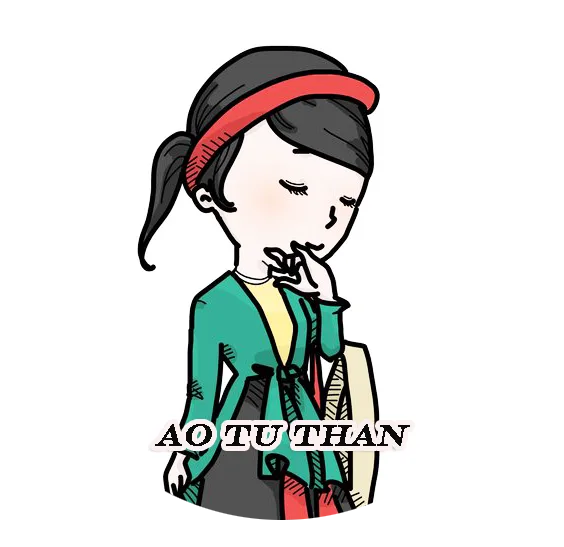
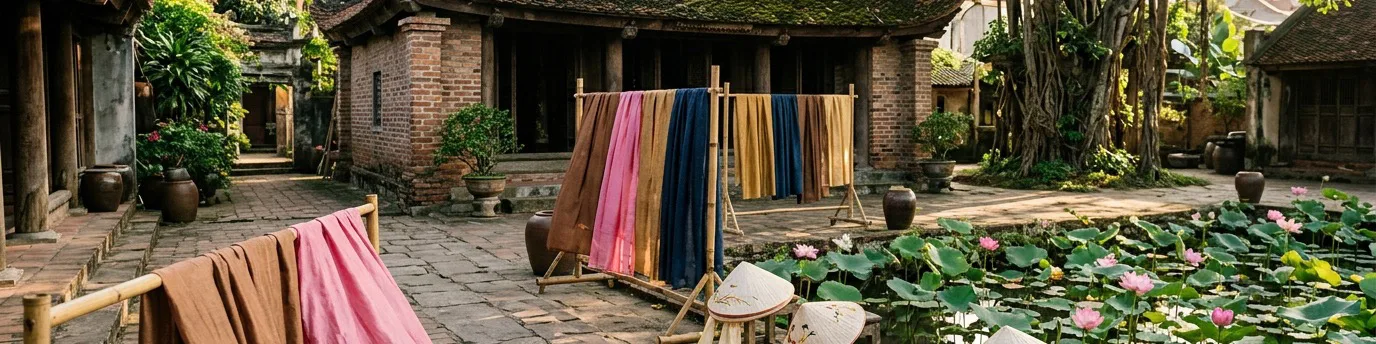
Paired with the delicate silk yem bodice is the flowing, graceful silhouette of the Ao Tu Than. Historically, the birth of this four-panel dress was closely tied to ancient Vietnamese handloom weaving techniques, which produced narrow strips of cloth measuring roughly 40 centimeters in width. To tailor a complete outer robe, weavers joined four vertical strips of fabric together. Its direct predecessor was the cross-collared tunic (ao giao lanh), whose two front panels crossed loosely over the chest without being tied. Later, to achieve greater freedom of movement while working in the rice fields or trading at village markets, resourceful Vietnamese mothers and sisters began knotting the two front flaps neatly at the waist, giving rise to the classic Ao Tu Than.
Festive Layers, Fabrics, and Deep Familial Symbolism
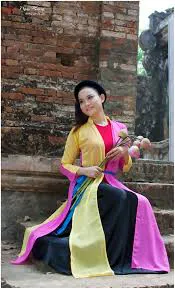
Over the centuries, several distinct variations of the garment emerged. In daily life, women wore a practical single-layer Ao Tu Than with the front flaps either hanging softly or knotted securely at the waist for market days. During spring and summer temple festivals, however, women favored the luxurious multi-layered ao mo ba (three robes worn together) or ao mo bay (seven robes layered with graduated collars and sleeves). Readers who wish to introduce the Ao Tu Than to new audiences often highlight its profound human philosophy: the four vertical panels represent the four parents (one's biological parents and parents-in-law), while the two front panels tied together symbolize marital devotion and lifelong fidelity between husband and wife. Depending on the wearer's means and the occasion, tailors crafted the robe from homespun cotton (vai tho), silk gauze (the), raw silk (to), Nam Dinh damask (linh Nam Dinh), brocade (gam), satin (voc), or fine crêpe (nhi).
The Art of the Khan Mo Qua Headscarf and Non Quai Thao Hat
Inseparable from the four-panel robe are the coiled hair wrap, the raven's-beak headscarf (khan mo qua), and the wide flat palm-leaf hat (non quai thao), which together define the speciality of the Ao Tu Than in Northern folk culture. Folding and tying a khan mo qua headscarf requires practiced skill and a sensitive eye for proportion. The pointed crow's-beak peak must sit at just the right height along the forehead: if tied too high, the face looks overly stern and elongated, whereas if pulled too low, the dark cloth casts a heavy shadow over the brow. When folded properly, the diagonal edges curve like a crescent moon around the cheeks, making a young woman's fair, rosy complexion glow like a pink lotus blossom against a dark pond.
Crowning the khan mo qua headscarf is the elegant non quai thao, a prized festive hat worn primarily during holidays, village processions, and Quan Ho singing gatherings. Traditional artisans crafted three main varieties of non quai thao:
- Non Xoan: The smallest and most compact version, featuring the lowest crown rim.
- Non Nga (or Non Ngang): A medium-sized, versatile flat hat favored for casual outings and festive strolls.
- Non Ba Tam: The grandest "three-span" flat hat, distinguished by its wide brim and taller crown rim, immortalized in the folk couplet: "Who crafted this non quai thao hat, leaving my heart longing for such a graceful maiden?"
From Ancient Bronze-Age Gowns to the Modern Ao Dai
No overview of Vietnam's national attire is complete without tracing how the Ao Tu Than connects to the modern ao dai. Flowing robes have existed in Vietnam since antiquity, with images of long-tuniced figures carved directly onto Dong Son bronze drums. According to folk legend, when the heroic Trung Sisters (Hai Ba Trung) rode war elephants into battle against northern invaders, they wore resplendent golden two-panel robes beneath gilded canopies. Out of deep reverence for the two national heroines, Vietnamese women in subsequent centuries avoided wearing two-panel robes and instead wore the four-panel Ao Tu Than.
By the 19th and 20th centuries, the long gown evolved alongside the Ao Tu Than as a common custom of women in Kinh Bac to become an indispensable garment across Vietnamese society—from queens and princesses in imperial palaces wearing gold-embroidered brocade robes to schoolgirls and city women strolling through bustling streets. Through waves of historical change and Western fashion influences—from artist Cat Tuong's 1930s Le Mur reform and pinched-waist silhouettes to Madame Nhu's (Tran Le Xuan) boat-neck style and modern floor-length panels—Vietnamese traditional dress has retained its unmatched ability to exalt a woman's gentle posture, as documented throughout our characteristics archives. Across thousands of years and despite relentless foreign assimilation pressures, Vietnam's traditional costumes have preserved a timeless, unmistakable cultural identity.