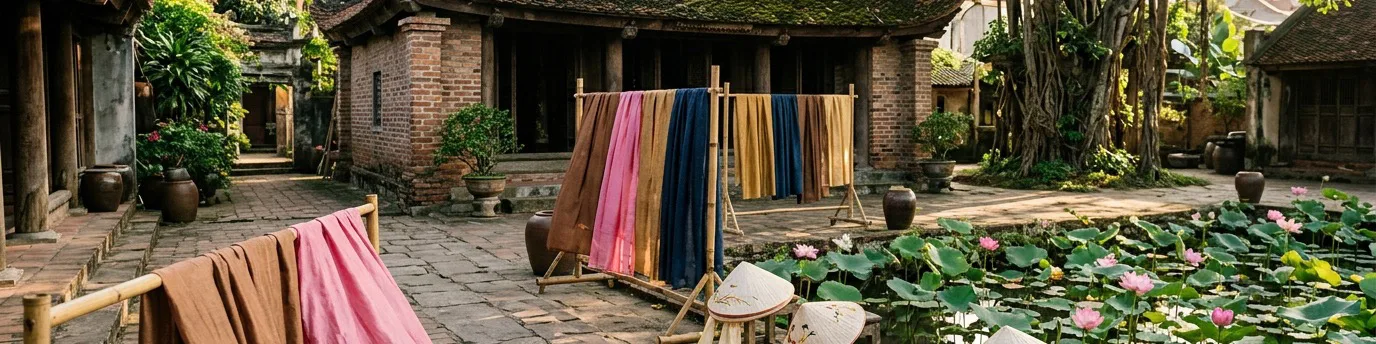
The Ao Tu Than (four-part dress) stands as the quintessential traditional costume of women in the ancient Ao Tu Than heritage of the Kinh Bac homeland. For centuries, rural women wore the Ao Tu Than as their everyday attire in farming, weaving, and community life until the early twentieth century, when modern tailored clothing gradually took its place in daily routines. Today, the Ao Tu Than is treasured primarily during traditional village festivals, especially in lyrical Quan Ho folk singing gatherings where male singers (lien anh) and female singers (lien chi) exchange poetic verses of lasting affinity. Created alongside the iconic melodies of Kinh Bac Quan Ho folk music, the four-part dress remains inseparable from Northern Vietnamese folk culture; whenever people speak of Quan Ho songs, the graceful silhouette of the Ao Tu Than immediately comes to mind.
Distinctive Four-Panel Construction and Silk Layers
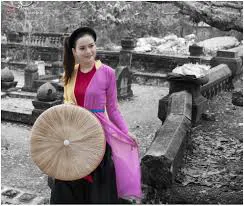
Structurally, the back of the coat consists of two full-length fabric panels sewn together along the spine, traditionally dyed in earthy brown or deep mahogany hues and paired with a broad, flat palm-leaf hat (non quai thao). At the front, two separate panels hang loosely and are tied together gently at the waist, draping smoothly over a slender figure while leaving the upper chest slightly parted to reveal the delicate lotus-petal bodice (yem) layered underneath. Reaching nearly to the heels, the long-sleeved outer tunic is worn over wide-leg black silk trousers and bound with vibrant colored silk sashes. Completing the ensemble is the classic square crow-beak headscarf (khan mo qua). In traditional village etiquette, stepping out in an Ao Tu Than without the crow-beak kerchief was considered as incomplete as wearing formal attire without proper shoes, a standard celebrated throughout our traditional Vietnamese costume beauty archives.
The Art of Folding the Crow-Beak Headscarf
However, not everyone knows how demanding it is to fold and tie a truly flattering headscarf so that Kinh Bac women look gentle and radiant in Ao Tu Than attire. Seasoned village elders explain that the kerchief must be proportioned carefully to the wearer’s facial contours so that it frames the face like a blooming lotus bud. If the pointed crow beak sits too high above the forehead, the wearer’s features appear overly rigid and angular like a relief sculpture; conversely, if the beak droops too low over the brow, it casts a heavy shadow across the eyes.
To craft a balanced crow-beak headscarf that captures the authentic soul of the Vietnamese countryside in the Ao Tu Than, the hair is first combed neatly and tucked inside a long cloth hair roll (khan van toc). This hair coil is wrapped around the crown in a slightly oval ring that settles gently at the nape of the neck and is pinned securely. Next, a black square cotton or silk scarf is folded diagonally into an even triangle, creased sharply at the center of the hairline to form the crisp crow-beak peak, and its two side corners are drawn smoothly behind the ears and tied neatly beneath the coiled bun at the nape.