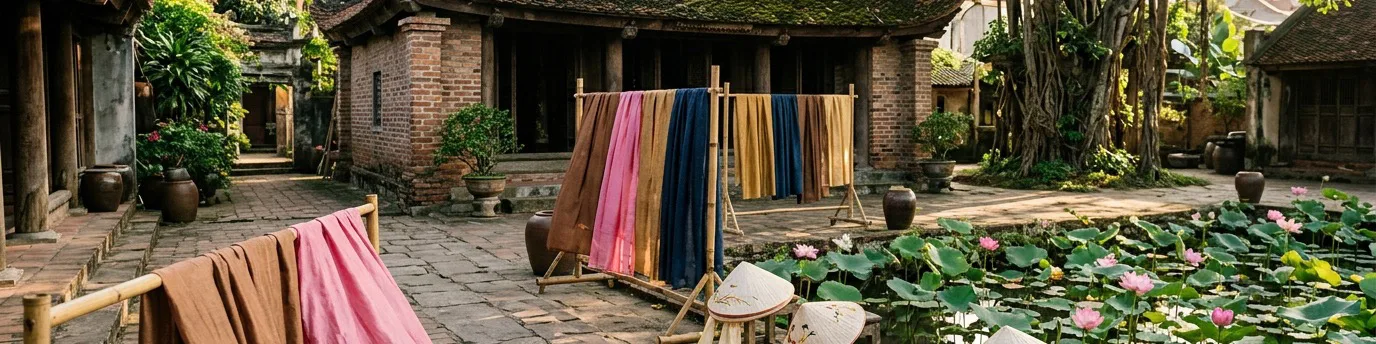
Skilled tailors across Hanoi and the neighboring Kinh Bac heartland have long been admired for their refined needlework, preserving the Ao Tu Than as one of the oldest documented traditional costumes for Vietnamese women. When worn for festive occasions, the four-part dress is often accented with a graceful blue or green silk drawstring pouch suspended from the waist. In practical everyday life, women tied a hollow cloth money belt (ruot tuong) around their midsection to secure coins and small personal essentials. Women from prosperous households also wore a decorative silver chatelaine (xac) at the hip to carry miniature betel-leaf cases and lime pots. Over time, urban artisans also adapted the open four-part robe into the buttoned five-panel tunic (ao ngu than), fastened with five small brass or jade buttons over a white silk camisole and traditional yem bodice, demonstrating why women in Kinh Bac appear so gentle and graceful in Ao Tu Than customs.
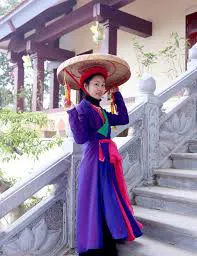
Discreet Elegance Across Historical Eras
Residents of Hanoi and the Red River Delta cultivate a distinctive sartorial philosophy. They value clothing that radiates quiet dignity, modesty, and harmonious proportion rather than ostentatious or flashy display. These cultural hallmarks were steadfastly maintained even through decades of wartime hardship, post-war scarcity during the subsidy period, and the rapid social transformations of economic opening. While each historical era introduced its own silhouettes, every generation adhered to a single unifying ideal celebrated in our traditional beauty and heritage archives: understated elegance.
Before 1954, women from scholarly and bourgeois families paid careful attention to every step and garment, wearing flowing long tunics whenever they went into town. Even within traditional merchant households, women wore neat long robes at home when welcoming guests. For seasonal festivals and Lunar New Year celebrations, families preserved luxurious silk and brocade outer robes, while working women in the countryside and market streets favored durable brown four-part tunics and practical three-pocket blouses.
Adaptation and Revival in Modern Thang Long
Following the return of peace to Northern Vietnam in the mid-twentieth century, older women from traditional urban families initially hesitated to trade their flowing tunics for simple modern blouses, whereas younger generations adapted quickly to active civic life. Consequently, ceremonial long gowns became rare in everyday street scenes from the 1960s through the late 1980s, appearing primarily on stage or during sacred family milestones.
By the early twenty-first century, alongside formal national attire—such as the women’s flowing tunic and men’s tailored Western suits, vests, and dress shirts—Hanoi designers introduced creative contemporary collections suited to all social groups, including designer Xuan Thu’s innovative Ao Tu Than collection with brown pottery patterns. Even as global fashion trends accelerate modern urban life, generations living across Hanoi’s Thirty-Six Old Streets continue to safeguard the refined spirit of ancient Thang Long culture. Young women effortlessly pair modern silhouettes with the poised manners of Trang An heritage, proving once again why the Vietnamese woman remains timelessly beautiful in the Ao Tu Than. Through every historical shift, the harmony between modest demeanor and refined tailoring endures as an unmistakable cultural signature of Hanoi and the Kinh Bac homeland.