Authentic photographs of Vietnamese women from the late nineteenth century are remarkably rare today, with most visual impressions preserved through historical stage reconstructions, cinema, and archival studies in our traditional Vietnamese beauty archives. Yet the image of a rural Northern woman dressed in the flowing Ao Tu Than has long entered folk poetry and collective memory as an enduring symbol of grace, resilience, and quiet nobility in ancient Vietnam.
Handwoven Fabrics and Natural Earthy Dyes
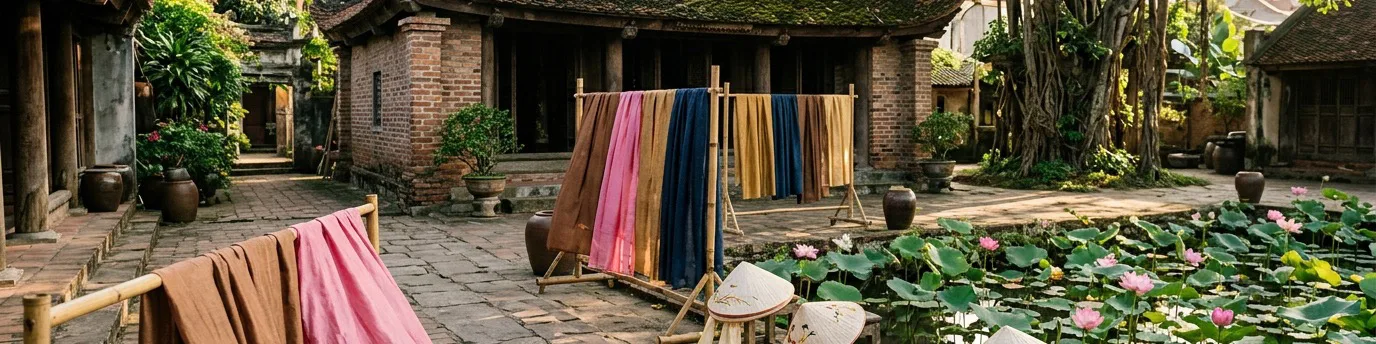
Woven from narrow strips of homespun fabric, the traditional Ao Tu Than features two unfastened front panels that cross or tie gently at the waist with a silk sash—a signature look of nineteenth-century Northern Vietnam. The upper chest remains slightly open to reveal the delicate ao yem bodice beneath, traditionally crafted from natural white or creamy-white silk fibers. Over this inner layer, the outer four-part robe was dyed using natural brown tuber extract (cu nau) to produce warm shades ranging from deep crimson-brown to earthy chestnut, a durable finish ideally suited for hardworking rural life.
Although elderly women in modern villages no longer wear these multi-layered outfits as daily workwear, many families across ancient Northern villages still carefully preserve hand-dyed heirloom garments passed down by their grandmothers. These treasured textiles offer younger generations an authentic window into Vietnam’s agrarian past, honoring the diligence and devotion of rural mothers and sisters—a theme often celebrated by those seeking the Ao Tu Than in traditional Quan Ho folk songs.
The Artistry of the Non Quai Thao Hat
Completing the ensemble was the iconic flat palm hat (non quai thao), which a nineteenth-century French physician once described as a wide, flat-topped circular hat measuring roughly sixty to seventy centimeters in diameter. Along both sides hung six or seven braided silk cords shaped like delicate quills, with a central loop resting gracefully across the chest. Attached to the inner crown was a chin strap adorned with black or creamy-white silk tassels draping below the ears.
The classic portrait of a Northern woman combined the Ao Tu Than, the wide-brimmed palm hat, hair coiled neatly in a cloth turban, bare feet, and glossy black-lacquered teeth. The finest hats were meticulously crafted from select palm leaves lined inside with thin, tightly woven bamboo filaments. Wealthier women adorned their hats with engraved silver hooks holding silk pompons and even pasted a tiny round mirror inside the crown to check their hair while walking to village festivals.
Everyday Practicality and Poetic Hairstyles
Between 1919 and 1926 in Northern Vietnam (then known as Bac Ky), women paired the tunic with a black skirt (vay dup). Working women in the rice fields wore calf-length skirts for ease of movement, while urban women wore sweeping ankle-length skirts. In warm weather, the breathable silk yem bodice worn beneath the robe provided both comfort during fieldwork and a liberated, graceful aesthetic.
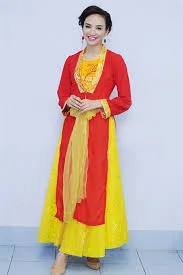
Whether at home or outdoors, a woman’s hair was always kept neat rather than left loose. Northern women gathered their long hair into a smooth roll wrapped inside a narrow cloth tube (khan van), coiling it securely around the crown of the head and leaving a small tuft of hair at the end called the duoi ga (rooster tail), complementing the Ao Tu Than and kerchief charm of Kinh Bac women. Even as modern ambassadors like runner-up Hoang My choose the Ao Tu Than as national costume, the nostalgic image of the four-part dress, silk bodice, palm hat, and wooden clogs remains an unforgettable emblem of Vietnamese cultural identity.