To this day, no one knows the exact date the Áo tứ thân originated, yet looking back through antiquity reveals the silhouette of a long two-flapped robe billowing in the wind carved onto the Ngọc Lũ bronze drum thousands of years ago—an enduring symbol highlighted across our Vietnamese traditional beauty archives.
The Trưng Sisters Legend and Four-Panel Tailoring
According to legend, when the Trưng Sisters (Hai Bà Trưng) rode war elephants into battle beneath golden parasols to drive out the Han invaders, they wore long two-panel yellow robes. Out of deep reverence for them, Vietnamese women avoided wearing unbroken two-panel robes and instead wore the four-part áo tứ thân. Another practical reason is that ancient weaving techniques were simple and rustic; narrow handlooms could not weave wide cloth, so tailors joined four fabric panels together to create the long gown, a craft tradition explored in our feature on traditional costumes associated with the Áo tứ thân. The resulting áo tứ thân has two front flaps of equal width knotted together at the waist.
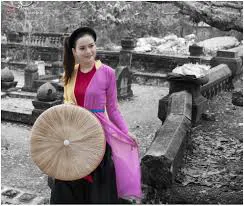
When wearing the áo tứ thân, women tied colorful silk sashes alongside a long tubular cloth pouch (ruột tượng) holding coins and small items around the waist. Across centuries of historical ups and downs, the flowing four-panel dress endured. From the seventeenth to nineteenth centuries, to project a formal, noble appearance, urban women adapted the four-panel garment into the five-panel robe (áo ngũ thân) to demonstrate wealth and social status while symbolizing the Five Elements (ngũ hành). Paired with a silk yếm bodice, a crow-beak kerchief (khăn mỏ quạ), and a flat palm hat (nón quai thao), the áo tứ thân formed the treasured traditional attire worn to temples and communal shrines.
The Art of the Kinh Bắc Crow-Beak Square Kerchief
Speaking of Kinh Bắc women’s attire—celebrated when discovering the Áo tứ thân in Quan Họ songs in part one and continuing in part two of our Quan Họ folk song series—means admiring not only layered silk robes, bordered yếm necklines, green silk sashes, softly pleated dark raw-silk skirts (váy sồi), and curved-toe slippers (dép cong), but also an indispensable detail: the black square kerchief (khăn vuông mỏ quạ).
Tying the crow-beak square kerchief is a delicate art—not everyone who sings folk songs knows how to tie it properly, and not everyone who wears it can fold a graceful peak. Experienced elders say the crow-beak peak must fit the wearer’s facial contours so that, once tied, her face resembles a blooming lotus. If worn too high on the forehead, the face looks bare and stark; if pulled too low, the countenance appears shadowed and dim.
To wear the crow-beak kerchief beautifully, a woman must first wrap her hair smoothly inside a cloth roll, coiling it neatly across the top of the head in a gentle oval resting toward the nape and pinned securely. More importantly, she folds the square black kerchief diagonally into a symmetrical triangle, pinching the center crease at the forehead into a crisp crow’s beak while the two side corners sweep past the ears and tie beneath the chin. Truly, the crow-beak kerchief is not merely a head covering, but a work of living artistry among Kinh Bắc women.