In Bac Ninh province, master tailor Duong Minh Ngoc—who has spent more than a decade dedicating her craft to sewing traditional Quan Ho ensembles and dressing generations of male and female folk singers (lien anh and lien chi)—speaks of the garment with deep reverence. "The Ao Tu Than is the signature attire of Quan Ho, an unmistakable emblem of Bac Ninh folk song culture," she explained. "The heartfelt warmth of Quan Ho people is expressed not only through lingering melodies and poetic lyrics, but also through dignified, authentic dress. If a costume lacks proper craftsmanship or strays from tradition, even the sweetest singing loses part of its soul and flavor."
The Anatomy and Handcrafted Precision of a Quan Ho Ensemble
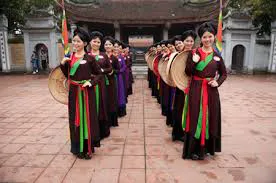
According to Ms. Ngoc, a complete ensemble for a female singer (lien chi) requires far more than just an outer tunic. It encompasses a diamond-shaped bodice (yem), contrasting silk waistbands (that lung), a black crow-beak headscarf (khan mo qua), a softly draped dark skirt (vay dup), upturned-toe embroidered slippers (hai cong mui), and the wide flat palm hat with fringed silk straps known as the Non Quai Thao, components closely examined in traditional costumes of Vietnamese women associated with the Ao Tu Than (Part 2). For male singers (lien anh), the attire is more understated yet equally refined, pairing a long silk tunic (ao the) over white trousers with a neatly pleated turban (khan xep). Creating these garments demands not only technical mastery but also genuine devotion to heritage tailoring. Seamstresses must possess extraordinary patience and precision because the visible stitches on the robe must be tiny and nearly imperceptible. Most seams and edges are hand-stitched and delicately rolled by hand so that the tunic panels float effortlessly in the breeze and the skirt drapes with liquid softness.
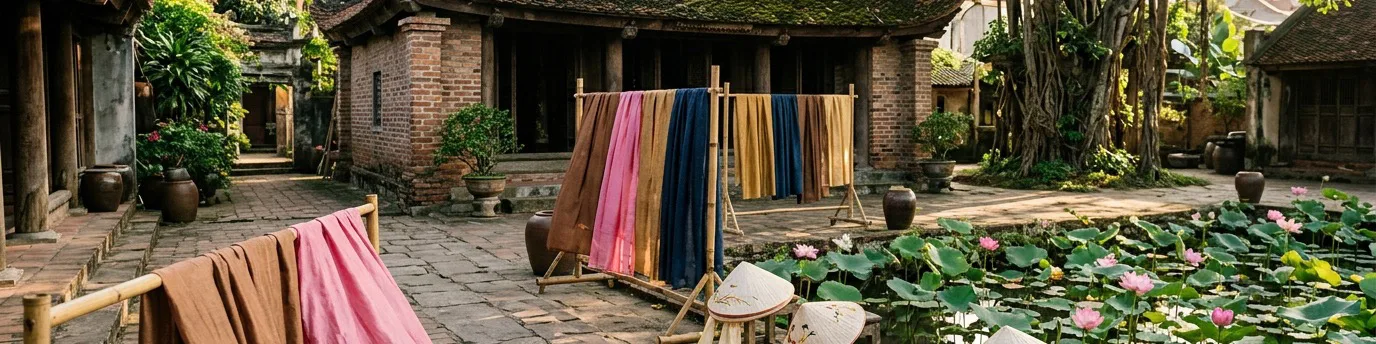
In earlier centuries, the quiet elegance of Quan Ho attire relied on classic indigenous textiles: Ha Dong silk for the outer robes, dark purple cloth or glossy black linh satin for the skirt, black satin or velvet for the square crow-beak kerchief, and lustrous silk or raw tussah silk (dui) for the waistbands. Today, modern Quan Ho costumes have evolved in fabric variety, color richness, and durability while preserving the foundational aesthetics described in the history of the Vietnamese Ao Tu Than. Because contemporary fabric bolts are woven much wider than antique handloom strips, tailors no longer need to piece together four narrow panels in the exact old manner; the two back panels are joined seamlessly down the spine while the front panels remain split, allowing the robe to flatter the wearer's figure with even greater fluidity.
The Art of Layering: Ao Mo Ba and the Cyan Lapel
Subtle refinements in color coordination and two-layer construction also give modern singers a slender, graceful silhouette. One of the most distinctive creative hallmarks is the stylized "turned lapel" (la lat) at the chest, where a vibrant cyan inner collar folds outward over the bodice, giving a two-layer tunic the rich visual depth of a traditional three-layer robe (ao mo ba). In this classic color triad, the cyan lapel represents the innermost tunic, the middle layer shines in lotus pink or crimson, and the outermost gauze robe drapes in rich mahogany brown (mau canh gian, or cockroach-wing brown)—the quintessential earth tone of Kinh Bac that no other shade can truly replace. Paired with a bright crimson yem bodice beneath the cyan lapel, the ensemble creates a breathtaking focal point for every lien chi.
Having spent years perfecting traditional tailoring for Quan Ho performers across Bac Ninh, Ms. Duong Minh Ngoc emphasizes how innovative touches must always serve tradition. By blending heritage cuts with refined modern tailoring, the costume celebrates radiant feminine grace. When the hand-sewn silk robes are layered properly and the headscarf is tied with care, the singers stand out against the rural landscape with timeless poise. For women, the inner hair coil (khan van) is wrapped fuller at the forehead and tapered toward the nape to shape a soft oval countenance; once topped with the folded crow-beak kerchief, it frames the face like a blooming lotus, a styling tradition further detailed in traditional costumes of Vietnamese women associated with the Ao Tu Than (Part 3). For men, the pleated turban is wound in seven or nine layers following the traditional yin-yang principle of auspicious odd numbers, lending the wearer a scholarly and dignified bearing.
Preserving Heritage at the Spring Lim Festival
In contemporary cultural life, stage performances of Quan Ho are far more common than the intimate, unamplified village house gatherings of the past. Consequently, performance costumes have embraced brighter palettes and decorative flourishes. The multi-layered Ao Mo Ba Mo Bay (three-robe and seven-robe ensembles) now appear in a wider spectrum of colors suited to individual performers, while the inner yem bodice is often embellished with shimmering sequins or vertical embroidery so the chest gleams beneath the open outer robes. "Yet no matter how much stage fashion evolves, the foundational rules of traditional Quan Ho dress must always be respected and preserved," Ms. Ngoc affirmed. "Performers may request new color harmonies or finer fabrics, but they never omit a single traditional accessory or alter the core structure of the tunic. That unwavering standard is what keeps the soul of Quan Ho unmistakable."
Every spring, around the twelfth and thirteenth days of the first lunar month, visitors from across Vietnam and around the world gather at the Lim Festival in Tien Du District, Bac Ninh Province, immersing themselves in the warm hospitality of local folk singers. Amid the festival crowds, the sight of fluttering Ao Tu Than panels, layered Ao Mo Ba Mo Bay robes, silk umbrellas, and pleated turbans holds an irresistible charm. Many travelers journey to Lim hill simply to admire the seasonal beauty of these traditional garments—a cultural treasure unique to the Kinh Bac homeland, celebrated across our traditional beauty features.
Veteran artisan Nguyen Thi Ban fondly recalled that in the old days, ancient Quan Ho was sung purely acappella, with voices carrying across the night from one harvest season to the next. Her own love for the art began in the womb, listening to her mother hum classic melodies while expecting her. "Perhaps because I absorbed those melodies before I was even born, I have remained deeply enchanted by ancient Quan Ho my entire life," Elder Ban reflected. According to the venerable artisan, the enduring beauty of the Ao Tu Than has played a vital role in honoring Bac Ninh Quan Ho folk songs both across Vietnam and throughout the world.