Worn gracefully over the black crow's-beak kerchief (khăn mỏ quạ), the Nón Quai Thao—a wide, flat-topped palm hat secured with a braided silk chinstrap—is one of the most treasured, refined, and luxurious accessories in traditional Northern Vietnamese dress. In centuries past, village women reserved this elegant hat exclusively for spring festivals, temple rituals, and communal celebrations rather than everyday labor in the fields. Because it was crafted specifically as ceremonial attire, the nón quai thao became an indispensable companion whenever a woman dressed in the classic Ao Tu Than and the charming culture of Vietnamese people.
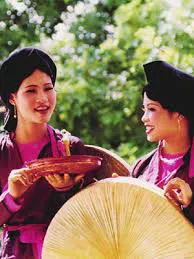
The Poetic Form and Varieties of the Non Quai Thao
For generations, the image of this wide flat hat has lingered in the hearts of rural youth through traditional folk songs (ca dao):
"Who crafted the Nón Quai Thao hat,
Leaving my heart filled with longing for her gentle grace?"
Unlike the pointed conical hat (nón lá), the nón quai thao has no peak. Instead, its crown is completely flat and round like a woven tray, generously proportioned with a diameter of approximately 70 to 80 centimeters and a vertical rim (thành nón) measuring 10 to 12 centimeters high. Across different regions and historical periods, this flat-crowned hat was also known as nón bẹt (flattened hat), nón thúng (basket hat, immortalized in the idiom "nón thúng quai thao"), nón chủng, or nón Nghệ. During the Trần Dynasty, the royal court refined the proportions of this headwear for women and named it nón Thượng—a style praised in the classic folk verse: "Sixth, I love the gentle Nón Thượng with its braided silk chinstrap."
Historically, traditional artisans classified these flat palm hats into three distinct varieties based on diameter and rim height:
- Nón Trường: The smallest and lightest variety, featuring the lowest vertical rim for subtle, understated elegance.
- Nón Nhỡ (also called Nón Ngang or Nón Đấu): A medium-sized flat hat with broader proportions suited for festive strolls and village gatherings.
- Nón Mười (also called Nón Ba Tầm): The grandest and widest-brimmed variety, constructed with a taller rim and dramatic ceremonial presence.
Another beloved folk verse celebrates the cherished value and romantic symbolism of this headwear in village courtship:
"This hat is worth a hundred strings of ancient coins,
This hat shields our heads from scorching sun and sudden rain,
This hat is made to shelter the two of us together."
Master Hat-Making in Chuong Village
The finest nón quai thao hats were traditionally handcrafted in Chuông Village (làng Chuông), Phương Trung Commune, Thanh Oai District, formerly in Hà Đông Province. The broad flat surface and rim of the hat are thatched with carefully selected palm leaves (lá cọ or lá gồi). Artisans inspect each leaf to ensure the blade is thin with delicate ribs, harvesting leaves that are neither too mature nor overly tender. Old palm leaves dry into a dark yellow tone and are used only for sturdy pointed work hats worn against sun and rain in the paddies, whereas young palm leaves cure into an amber-gold shade reminiscent of the poetic conical hats of Huế. At the center of the underside sits a cylindrical inner bamboo crown (khua nón) about 8 centimeters high, woven in an open hexagonal lattice so the hat rests securely atop the wearer's head. Because the wide palm canopy has substantial weight, this inner bamboo ring must be braided with exceptional firmness.
The structural frame (khuôn nón) consists of slender bamboo splints shaved smooth and polished to a glossy sheen, then painstakingly stitched together with white silk thread or tough translucent fiber as fine as fishing line. Beneath the flat canopy, artisans decorate the interior lining with delicate gold and silver paper cutouts shaped like blooming flowers, songbirds, and butterflies—a decorative style known as nón hoa. In especially luxurious hats, a small round mirror is mounted inside the crown, and colorful threads are woven back and forth across the inner bamboo ribs, inspiring the folk couplet: "Two silken rings twine gracefully around the butterfly wings." These outer accessories complement the inner garments explored in Part 3 on the traditional yếm bodice and skirts.
The Braided Silk Chinstrap of Trieu Khuc Village
To hold the wide hat gracefully in place, women use a specialized braided silk cord known as the quai thao. Triều Khúc Village in Thanh Oai District, Hà Đông Province—situated about 8 kilometers from central Hanoi along the Hanoi–Hà Đông road and colloquially known as "Đơ Thao Village" (làng Đơ Thao)—was famous across Northern Vietnam for weaving these silk straps. Together, the áo tứ thân and the nón quai thao formed a timeless emblem of feminine grace celebrated throughout our Beauty Archives.
Weavers from Triều Khúc traveled to traditional silk-reeling villages to purchase raw silk and sort the fibers into two distinct grades for strap making. The first grade, tơ đũi, consisted of coarse, slubby filaments spun from outer cocoons; the second grade, tơ nõn, consisted of fine, lustrous silk filaments that were easy to dye in soft lotus-pink hues or leave pearl-white to weave smooth outer casings. Multiple strands of silk were braided continuously around a central core—much like a lamp wick—to create a plump, supple cord. Once braided, the silk rope was knotted at intervals into decorative macramé segments that added both artistic beauty and tensile strength.
A complete quai thao chinstrap consists of two or three braided silk cords measuring 1.5 to 2 meters long, joined as a double strap (quai kép) that loops under the chin and drapes softly down to the waist. When a woman lightly holds the silk cord in front of her chest with her right hand, the broad hat stays balanced against the wind and can be tilted effortlessly to shade her face. At either end of the cord, where the strap meets the bamboo rim, sit two thumb-sized woven silk pom-poms called quả găng, from which hang silken tassels (tua chỉ) measuring 20 to 25 centimeters long accented with a dozen smaller decorative knots. Walking too hastily would cause the wide hat and long tassels to sway and brush against the hands, naturally encouraging young women to walk with slow, measured, and poised steps—a graceful gait that also harmonized with the traditional footwear described in Part 4 of our Vietnamese traditional costume series.
Unmarried maidens traditionally favored pure pearl-white silk straps, whereas married women chose deeper shades of black or dark brown. Women from prosperous urban households or gentry families further embellished their hats with engraved silver ornaments known as kép bạc and thẻ bạc. The kép bạc was a square silver plaque embossed with twin dragons flanking the moon (lưỡng long chầu nguyệt) and fastened to the rim of the inner bamboo crown, while the thẻ bạc consisted of a pair of floral-engraved silver medallions—each the size of three coins with small rings attached—pinned to both sides of the hat to anchor the braided silk straps.