While traditional Vietnamese men dressed in long ceremonial tunics—tailored from stiffened black gauze (vải the), silk, or brocade—paired with quần lá tọa (wide, straight-legged trousers cut with a deep rise reaching high above the waist, allowing the wearer to hike the legs up for fieldwork or fold the excess top waistband down over a sash), fewer modern readers are familiar with the distinctive trousers and footwear that women wore alongside the Ao Tu Than and the charming culture of Vietnamese people during the nineteenth and early twentieth centuries.
Quan Chan Que: The Diagonal-Seam Wide Trousers
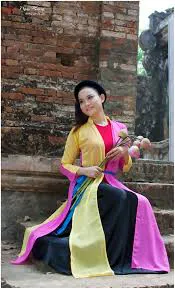
In two classic cultural essays—"Vietnamese Dress" (Y phục Việt Nam) by Trần Thị Lai Hồng and "Women of Hanoi" (Phụ nữ Hà Nội) by the renowned Hanoi cultural essayist Băng Sơn—both authors describe a unique style of early women's trousers known in folk speech as quần chân què (literally "asymmetrical-leg trousers").
Tracing the evolution of women's lower garments, Trần Thị Lai Hồng observed: "Women's trousers evolved from the wide-legged quần chân què fastened with a drawstring, to trousers with a folded waistband flap tucked at the back, then to side-buttoned waistbands, and finally to Western-style zippered trousers." Through all of these historical transitions, the four-panel dress and the Ao Tu Than and kerchief as symbols of past society remained cherished emblems of Kinh Bắc women. Essayist Băng Sơn likewise painted a vivid portrait of this layered silhouette: "Outermost is the flowing tunic that first catches the eye; second is the valance-draped skirt or the wide-legged quần chân què; and third are the three or seven colorful silk sashes tied modestly at the waist, their ends fluttering in the wind while concealing the inner knots beneath."
Why did folk tradition call these garments quần chân què? Visually, they were wide-legged, flowing trousers whose hems flared almost as broadly as a skirt. In earlier centuries, handwoven silk and cotton bolts were narrow—measuring only about 35 to 40 centimeters across—which was not wide enough to fold a single strip of cloth into a full trouser leg. To achieve the desired width without wasting fabric, tailors cut the cloth diagonally on the bias and pieced an extra triangular gusset strip onto each leg, while reinforcing the deep crotch (đũng quần) with a diamond-shaped cloth insert. Because each trouser leg was assembled from two unequal diagonal panels rather than a single symmetrical tube, villagers humorously named them quần chân què.
Traditional Bamboo Clogs and Imperial Wooden Clogs
When attending village festivals, temple fairs, or communal ceremonies, rural women completed their outfit with handcrafted clogs and leather sandals featured across our Beauty Archives. In the countryside, villagers carved sturdy clogs directly from thick bamboo roots and stems (gốc tre). The front tip was whittled with an upturned prow to protect the toes, and a small hole was bored near the front so a twisted rattan or bamboo-splint strap (quai mây) could anchor between the toes and loop across the arch of the foot. Known popularly as guốc Nghệ (originating from Nghệ An), these resilient bamboo-root clogs could last up to ten years before wearing out, tapping a crisp, rhythmic "cộp, cộp" sound with every step along brick village lanes.
In contrast to rustic bamboo clogs were guốc Kinh—delicate wooden clogs originating from the imperial capital of Huế. Crafted from light wood coated in white chalk paint, tinted rosy pink at the toe, and fitted with plush velvet or brocade straps, guốc Kinh projected aristocratic refinement. They were worn primarily by wealthy urban ladies and noblewomen who walked only short distances, as a few hurried steps on rough pavement could easily chip the painted wooden toe.
Buffalo-Hide Sandals and Curved-Toe Slippers
Among townswomen and market merchants, footwear was also fashioned from tanned leather, coconut fiber, or woven sedge. Two classic styles of handcrafted leather footwear were especially prized when dressing in the traditional Ao Tu Than and five-panel tunics explored in Part 5:
- Dép Một (Single-Layer Leather Sandals): Loved for its light comfort and durability, the dép một was cut from a single thick piece of manually tanned buffalo hide without a raised heel. It featured a horizontal strap across the instep and a small front cutout loop for the second toe. When walking, the flat leather sole brushed softly along the ground; in cities, women often lined the horizontal strap with velvet, inspiring the folk couplet: "Feet stepping in horizontal-strap sandals, / A silver ring upon her hand makes her all the more charming."
- Dép Cong (Curved-Toe Leather Slippers): Constructed from four or five layers of tanned buffalo hide laminated together and fastened with tiny bamboo pegs (đinh tre). The front tip curved steeply upward like a boat prow to shield the toes, while a small leather ring near the front slipped securely over the second toe to keep the slipper from sliding off. Because the multi-layered sole curved dramatically upward, the wearer could not rush and naturally glided with slow, poised steps—highlighting the serene, timeless grace of a woman dressed in the áo tứ thân.