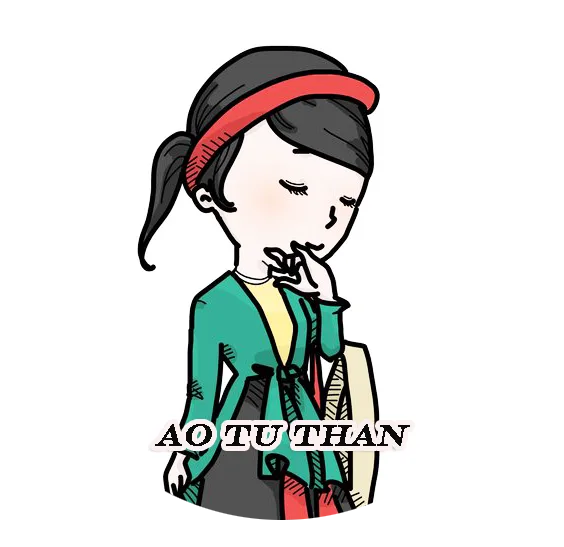
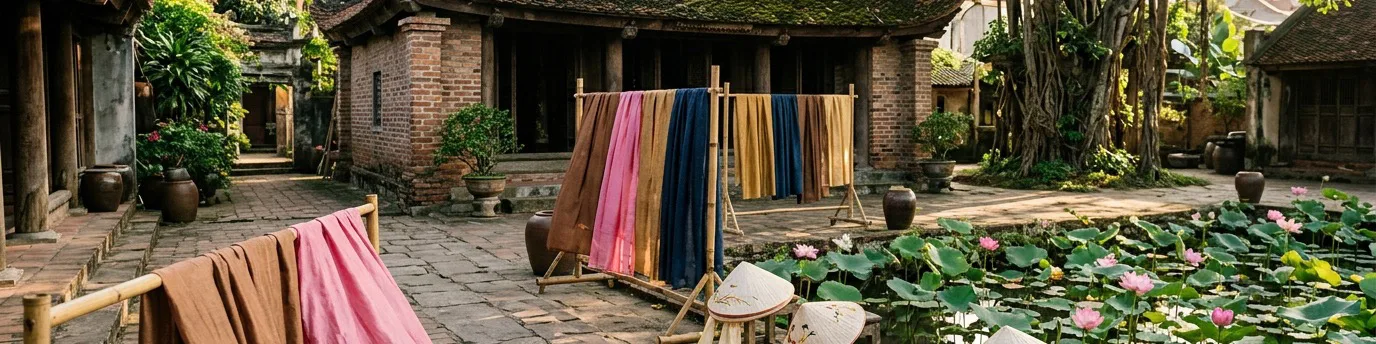
For generations, young women across the villages of Northern Vietnam grew up wearing the Ao Tu Than, even as this traditional four-panel garment gradually faded from everyday rural life. In prosperous households of the past, as soon as a young daughter reached the age of wearing her hair in a "peach-blossom tuft" (dau de chom trai dao), she was fitted with her own Ao Tu Than and a multi-layered silk waistband. Exploring our traditional Vietnamese beauty archives shows why this ensemble remains one of the most poetic expressions of village craftsmanship.
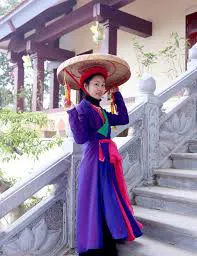
The Four-Panel Construction and Everyday Knots
The garment takes the name Ao Tu Than because its body is composed of four distinct cloth panels: two long front flaps that hang open at the chest and two back panels joined along the center of the spine. When tailored from fine silk for leisurely outings, the two front panels were often left to drape gracefully past the waist. By contrast, when women wore tunics dyed in light or dark yam brown for traveling or shopping at the village market, they knotted the two front flaps neatly at the waist into a compact bulb resembling a water caltrop or dram fruit (buoc vat cu au).
Festive Layers of "Three and Seven" and the Art of the Waist Sash
During village festivals, temple ceremonies, and especially when celebrating spring with traditional Tet customs in Vietnam, women dressed in luxurious layers known as mo ba mo bay—wearing three or seven thin silk tunics nested together and cinched with an array of colorful waist ties. Arranging these intricate waistbands required remarkable care and followed a time-honored sequence:
- The Bodice Ties (Dai Yem): Beneath the tunics sat the diamond-cut yem bodice covering the neck and chest, whose two long ties wrapped around the back and trailed down the waist in warm shades of creamy-white areca-flower or daylily blossom. Even when referred to as a "white bodice," it was never sewn from stark, unbleached white cloth—which was reserved for mourning—but rather from creamy off-white silk.
- The Tubular Waist Pouch (That Lung Bao): Worn by young maidens and eighty- or ninety-year-old grandmothers alike, this long tubular cloth belt wrapped snugly around the waist and tied in front. When filled with a small mirror, a handkerchief, copper coins, and folded banknotes, the pouch swelled plumply like a "chicken thigh" and served as a secure personal purse.
- The Outer Silk Sash (That Lung Ngoai): Over the waist pouch, women tied the longest outer sash crafted from lustrous dyed raw silk (lua soi) or shimmering crepe silk (lua nhieu).
With every gentle step a woman took, the outer sashes, bodice ribbons, and layered hems fluttered in unison, creating up to ten vibrant silk tails dancing at her waist—a timeless look that continues to inspire modern portraits such as the pure country-girl beauty of Truc Diem in Ao Tu Than.
Modesty and Boldness in Traditional Village Life
The outer Ao Tu Than was held neatly in place over the inner yem bodice. Although small spare buttons were occasionally sewn near the underarms, they were rarely fastened, and the collar remained open without buttons. Yet the wearer was never immodestly exposed, because the square-cut silk yem—dyed in light brown, peach, or plum with a rounded collar (co xay) or V-shaped neckline (co se)—covered the chest completely. Elderly women and young children, meanwhile, often wore side-buttoned shirts fastened securely against the breeze.
Interestingly, as historical accounts of how the Ao Tu Than and kerchief symbolized Vietnamese society in the past note, village dress customs also allowed surprising practicality during scorching summer months. Married women nursing their children at home or carrying heavy market baskets on shoulder poles often set aside the outer tunic altogether, wearing only the yem tied across the chest while leaving their back and shoulders bare to cool off—a bold summer privilege reserved strictly for married mothers that unmarried village daughters never dared to imitate.