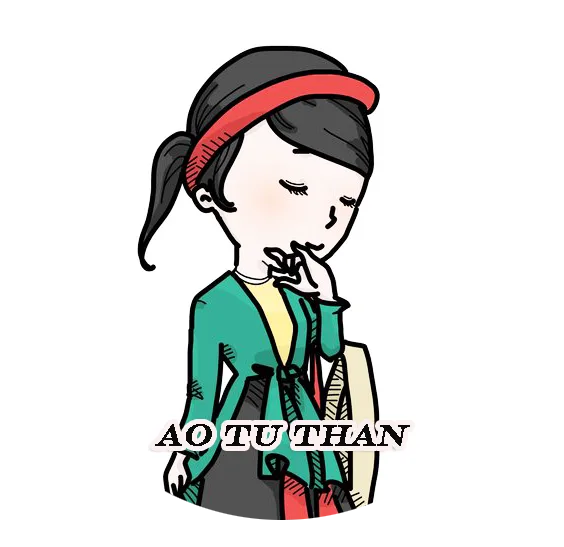
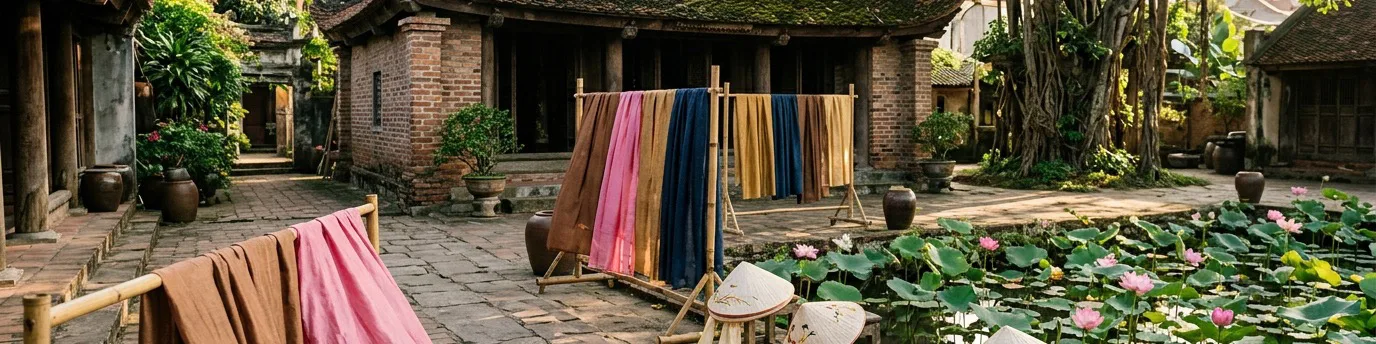
According to time-honored legend, when the heroic Trung Sisters (Hai Ba Trung) rode war elephants into battle to drive out the Eastern Han invaders, they wore flowing two-panel yellow robes beneath golden parasols. Out of deep reverence for the two queens, Vietnamese women subsequently avoided wearing two-panel garments and instead adopted the four-panel Ao Tu Than. Another practical explanation rooted in textile history is that early village handlooms were simple, rustic, and narrow; because weavers could not produce wide bolts of cloth, tailors joined four narrow strips of fabric together to create a full-length tunic. Visitors who wish to introduce themselves to the history of the Ao Tu Than will find that its two equal-width front panels knotted at the waist became an enduring emblem of Vietnamese life.
From the Four-Panel Tunic to Five-Panel Court Dress
When wearing the Ao Tu Than, women tied a colored silk sash around the waist alongside a long tubular cloth pouch (bao) used to hold copper coins and small daily essentials, knotting the ends neatly in front. Through centuries of historical upheaval, this flowing four-panel dress endured as a cornerstone of rural identity. Between the seventeenth and nineteenth centuries, seeking a more formal and aristocratic silhouette, urban and noble women adapted the four-panel robe into the buttoned five-panel tunic (Ao Ngu Than) to signify wealth, refinement, and social standing, with the five panels representing the Five Elements (Ngu Hanh) of Eastern cosmology.
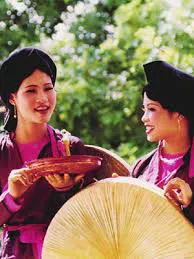
A complete traditional Ao Tu Than ensemble always required an inner silk bodice (yem), a black crow-beak headscarf (khan mo qua), and a flat palm hat with fringed straps (non quai thao)—forming the classic festive attire worn by mothers and daughters when visiting communal houses, pagodas, and ancestral shrines. Browse our traditional beauty archives to see how each element contributed to this harmonious silhouette.
The Art of Folding the Kinh Bac Square Crow-Beak Kerchief
When describing the traditional wardrobe of Kinh Bac women—with its layered silk tunics, high-collared bodices, green silk sashes, rustling pleated skirts, and curved-toe sandals—one small yet indispensable accessory stands out: the square crow-beak kerchief (khan vuong mo qua). Folk wisdom in Bac Ninh holds that not every young woman who knows how to sing Quan Ho automatically knows how to tie a crow-beak kerchief gracefully. Experienced elders explain that the kerchief must be folded and positioned to proportion the wearer's face so that her features resemble a blooming lotus:
- Positioning on the Forehead: If the kerchief is tied too high, the forehead looks stark and severe; if it sits too low over the eyebrows, the face appears shadowed and dim.
- Coiling the Hair Roll (Khan Van): Before putting on the outer kerchief, a woman must neatly wrap her long hair inside a tubular velvet roll, coiling it around the crown with a gentle oval curve toward the nape of the neck and securing it with a pin.
- Shaping the "Crow's Beak": The black square cloth is folded diagonally into a symmetrical triangle, with the center crease pinched into a crisp "crow's beak" peak at the middle of the forehead while the two side flaps sweep smoothly past the ears and tie neatly beneath the chin.
Far more than a simple head covering, the crow-beak kerchief was a work of folk artistry that enhanced the slender beauty of women wearing the Ao Tu Than across the Kinh Bac countryside.
Society, Regional Character, and Seasonal Festivals in Ancient Chronicles
Historical chronicles recording the customs of ancient Vietnam—known in antiquity as Giao Chi and later An Nam—provide vivid snapshots of the society in which these traditional garments flourished. From the eras corresponding to the Tang and Song dynasties onward, after administrative prefectures were established, Vietnamese society combined scholarly learning with a peaceful agrarian lifestyle: men ploughed the fields and engaged in trade, while women tended silkworms and wove silk and cotton on household looms. Chronicles noted that natives of Giao Chau and Ai Chau were generous and resourceful, while residents of Hoan Chau and Dien Chau were diligent and devoted to study, and upland communities preserved ancient tattooing customs inherited from the early Viet kingdoms.
Traditional dress shone brightest during the grand seasonal festivals recorded through the lunar year, many of which laid the foundation for celebrating spring with traditional Tet customs in Vietnam:
- The First Full Moon Lantern Festival (15th of the 1st Lunar Month): A towering lamp tree known as the Ngao Son Lamp was erected in the royal courtyard and lit with thousands of flames illuminating heaven and earth, while Buddhist monks chanted sutras in procession and mandarins gathered for the ceremony of "attending the lamps."
- The Spring Terrace Festivities (2nd Lunar Month): Performers dressed as the twelve deities sang and danced atop a pavilion called the Spring Terrace (Xuan Dai), while the king presided over martial arts and wrestling matches, rewarding the victors alongside games of shuttlecock, ball play, chess, and tug-of-war.
- Cold Food, Loyalty Oaths, and Summer Solstice Rituals (3rd to 5th Lunar Months): During the Cold Food Festival (Tet Han Thuc), families gifted one another rolled rice cakes; on the fourth day of the fourth lunar month, princes and officials took their annual oath of loyalty at the Dong Co Mountain God Temple; on the eighth day of the fourth month, fragrant sandalwood and frankincense water was prepared to bathe statues of the Buddha; and on the fifth day of the fifth lunar month (Tet Doan Ngo), crowds dressed in their finest tunics gathered along the riverbanks to watch royal dragon boat races.