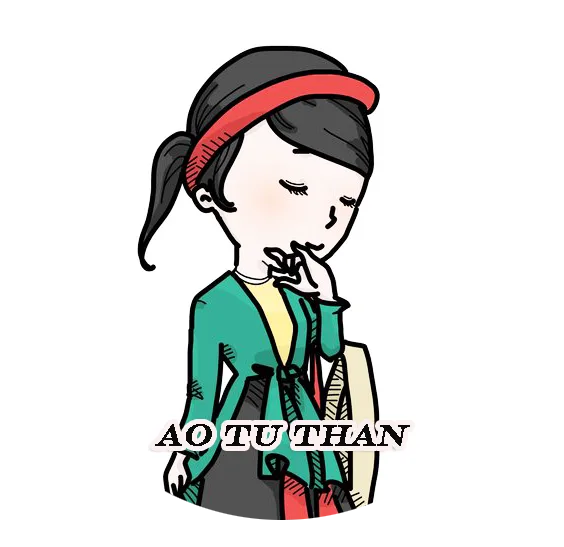
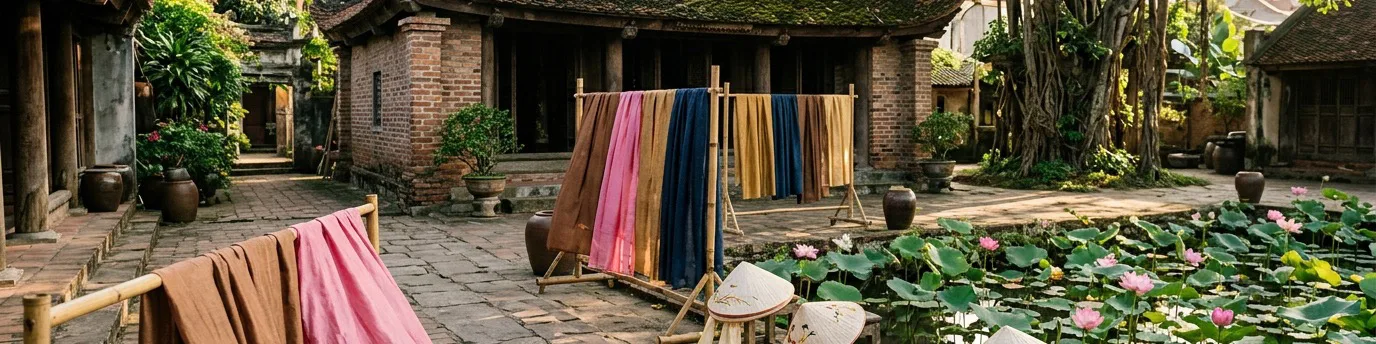
The Ao Tu Than (four-panel traditional tunic) is an iconic emblem of Northern Vietnamese female attire. Structurally, the garment includes two back pieces sewn together along the central spine seam, with the joined edges neatly finished inside the jacket, while the two front panels hang down separately in the middle and are tied together at the waist so the wearer can slip into the robe effortlessly without fumbling with small buttons. Worn alongside the outer tunic are the traditional yếm bodice and the crow-beak kerchief (khăn mỏ quạ), forming a classic ensemble explored across our Introduce Archives.
Traditional Tailoring, Layers, and Color Symbolism
In its familiar early twentieth-century form from the 1920s and 1930s, the Ao Tu Than fell approximately twenty centimeters below the knee, featuring two front flaps and two back flaps. Because traditional village handlooms at that time produced fabric rolls only thirty-five to forty centimeters wide, tailors had to stitch two vertical strips of cloth together along the back to form a complete rear flap—giving rise to the name Ao Tu Than ("four-panel dress"), as further explained in our companion guide to introduce Ao Tu Than.
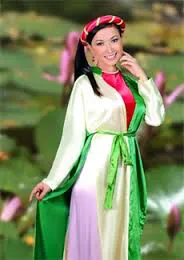
Designed without front buttons and tailored with two fitted long sleeves for the arms, the outer tunic is worn over an inner yếm bodice. Women wore either a rounded-neck bodice (yếm cổ xây) for daily farm work or a deep swallow-wing V-neck bodice (yếm cổ xẻ cánh nhạn) for festivals. Elderly matrons favored deep earth-toned bodices, whereas young unmarried maidens wore crimson or peach-blossom pink (yếm đào)—a vibrant shade celebrated in folk sayings as an enchanting charm to admirers. Over the yếm sat a thin white inner blouse (áo cánh mỏng), cinched around the waist with a bright green silk sash (dải lưng xanh) paired with a flowing black skirt (váy đụp or váy lĩnh). That green silk sash added a striking color accent while keeping the flowing panels neat and slender for both field work and festival outings.
The two-piece back coat was typically sewn from humble brown or tan handwoven cloth (vải nhuộm nâu non hoặc nâu sồng), while the two separate front panels were tied together at the waist, leaving the upper chest unfastened to reveal the colorful inner bodice and a narrow one-to-two-centimeter collar edge. On traditional theater stages, rural women's Ao Tu Than costumes often used dark cloth with round buttons tucked under the right arm. Used as everyday attire in Northern Vietnam into the early twentieth century, the Ao Tu Than is now worn primarily during traditional festivals.
Historical Origins and Cultural Evolution
Although no historical record pinpoints the exact date the Ao Tu Than first appeared, researchers studying the unique history of Ao Tu Than (part 1) have found carvings of flowing two-part tunics on Ngoc Lu bronze drums dating back thousands of years. Several folk legends and practical explanations account for its creation:
- Reverence for the Trung Sisters: According to legend, when the Trung Sisters (Hai Bà Trưng) led their uprising to expel northern invaders from the border, they wore long robes with two golden flaps. Out of respect, Vietnamese women avoided wearing unbroken two-panel robes and instead divided the front into four panels.
- Rudimentary Handloom Widths: Because ancient weaving looms produced narrow fabric strips roughly forty centimeters wide, four pieces of cloth had to be joined together to sew a full tunic.
- Evolution from Cross-Collared Tunics: To facilitate agricultural labor and market trade, the ancient cross-collared robe (áo giao lĩnh) with overlapping front lapels gradually evolved into the tied-front Ao Tu Than.
From early nineteenth-century photographs of Northern women to seventeenth- and nineteenth-century urban noblewomen who layered multiple colorful tunics to display refinement and luxury, the garment has endured across centuries. Today, the Ao Tu Than, kerchief, and flat palm hat (nón quai thao) remain preserved as a common custom of women in Kinh Bac by Quan Ho folk singers. While contemporary fashion designers have recently brought boldly stylized versions of the Ao Tu Than to international beauty pageants, many of these exaggerated adaptations still await broader support from the Vietnamese public.