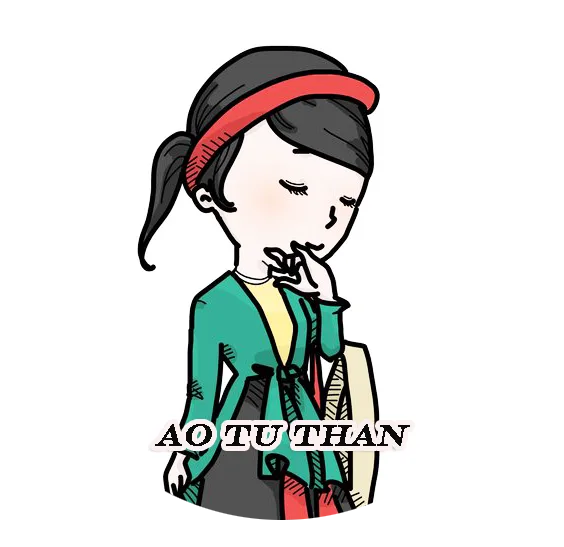
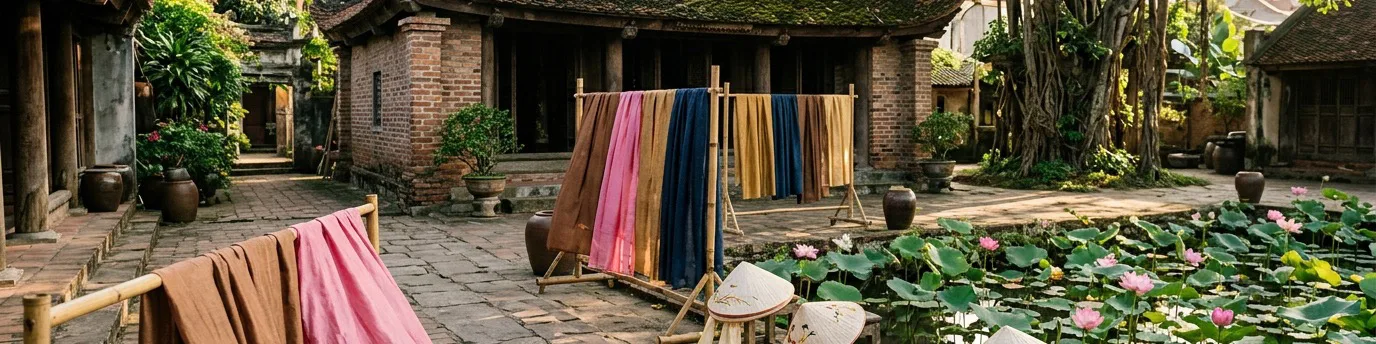
Within the richly colorful tapestry of traditional costumes worn across Vietnam's 54 ethnic groups, the attire of Kinh women stands out as a distinctive and refined cultural hallmark. One of the most beloved garments worn by working and rural women across Northern Vietnam up until the early twentieth century was the Ao tu than in Kinh Bac. Serving as their everyday attire as well as their festive dress, the Ao tu than is sewn from four narrow strips of cloth, featuring two front flaps left unfastened or gently crossed and held in place by a colored silk sash tied around the waist. The open front lapels reveal a delicate inner yem bodice—traditionally woven from natural white or creamy-white silk fibers—forming an essential centerpiece in the traditional costumes of Vietnamese women associated with the Ao tu than.
The Four-Panel Tunic, Crow-Beak Kerchief, and Non Quai Thao
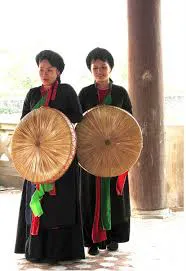
The diamond-shaped silk yem bodice allows a woman to subtly showcase her natural physical grace, including her bare shoulders and slender, willow-like back. Explaining the speciality of the Ao tu than, Ms. Pham Bich Hang, Head of the Communications and Education Department at the Vietnam Women's Museum, states: "The traditional Ao tu than consists of four narrow fabric panels: the two back panels are stitched together along the spine, while the two front panels are drawn across the body and tied together with colored silk ribbons, creating a flowing and graceful silhouette for the wearer. Combined with the Ao tu than is always an inner yem bodice, a crow-beak kerchief on the head, and a flat Non quai thao hat—an iconic image still lovingly preserved today by the women of the Kinh Bac homeland."
Accompanying the four-panel tunic is the classic black crow-beak kerchief (khăn mỏ quạ), cleverly folded along the diagonal into a balanced triangle so that its crisp raven-beak peak rests centered on the top of the forehead, while the two side corners fold neatly past the ears and tie securely behind the nape of the neck. Paired with the wide-brimmed Non quai thao hat—which shades the face from sun and rain when worn on the head, creates an airy, cool shelter, and honors the poised grace of Kinh women when held in hand during folk performances—this ensemble illustrates how the Ao tu than and kerchief express the enduring charm of the Kinh Bac woman.
Contrasting Regional Grace: The Southern Ao Ba Ba
Just as the four-panel robe represents the Northern plains, the Ao ba ba is forever associated with the women of Southern Vietnam. Farmers in the Mekong Delta historically wore black or brown Ao ba ba ensembles with matching dark silk trousers because the dark cloth stayed neat during farm work, washed easily, and dried quickly in the breeze. Furthermore, the shirt is slit at both sides of the hips to give the wearer comfortable freedom of movement, while two large lower pockets on the front bodice provide a convenient place to carry small everyday items such as matches or money. Because of its exceptional comfort and practicality, Southern women wore the Ao ba ba everywhere—to work in the fields, to shop at village markets, and to attend community festivities.
According to Ms. Pham Bich Hang: "The Ao ba ba was designed specifically to suit the river and canal environment of the Southern delta region. Rural farmers here frequently wear black or brown Ao ba ba sets because they are so practical. When Southern women wear the Ao ba ba, they almost always pair it with a checkered khan ran scarf woven with alternating two-color squares draped lightly over the shoulders, accentuating the rustic, sincere beauty of Vietnamese country women."
In later generations, urban women and tailors introduced thoughtful improvements to make the traditional Ao ba ba both modern and flattering. Rather than hanging straight and wide like earlier versions, contemporary shirts are tailored narrower with subtle darts at the waist and bust to gently hug the figure. Tailors also created diverse collar styles—such as lotus-leaf collars, swallow-wing necklines, and scalloped trims—adapted from international fashion trends. Sleeve construction evolved as well: whereas older shirts cut the body and sleeve in one continuous piece, in the 1970s Southern tailors popularized the raglan sleeve style, joining the front and back panels diagonally from the neckline to the underarm. Tailored to fit the waist softly without feeling restrictive, and often omitting the front pockets on dressier versions, the modernized Ao ba ba achieves a relaxed, feminine elegance.
The Evolution and Craftsmanship of the Vietnamese Ao Dai
Speaking of the traditional dress of Vietnamese women, one must also celebrate the Ao dai. Wherever they live, Kinh women feel deeply proud of the slender, body-hugging gown featuring a high stand collar and two long panels flowing from the neckline to the ankles over wide silk trousers that brush the ground.
Ms. Le Thi Quyen, owner of the historic Vinh Trach Ao Dai tailor shop at 23 Luong Van Can Street in Hanoi, who has sixty years of experience tailoring traditional long dresses, recalls: "In the old days, the traditional long gown was tailored with set-in shoulders and fastened with side buttons along the right lapel. The collar stood upright but was lower than today's styles, measuring only about three centimeters high, and the sleeves left a little breathing room around slender arms. Five-panel gowns tucked the inner flap neatly underneath rather than showing it off. Even with a square-cut shoulder instead of a modern raglan seam, the bodice still tapered gracefully at the waist and blossomed smoothly over the hips. Today, sewing raglan sleeves is simpler and highlights the soft, slender curves of a woman's waist."
When wearing the traditional long gown, mature women with long hair often coil their locks inside a circular velvet turban (khăn vấn) or wear a conical hat (nón lá), while younger women gather their hair into a ponytail or low bun for a youthful, modern appearance. Tailors craft the gown from an abundant variety of patterned silks adorned with hand-painted motifs or delicate manual embroidery. Summing up its cultural significance, Ms. Pham Bich Hang remarks: "The Ao dai symbolizes the cultural essence of the Vietnamese nation. Artist Cat Tuong was the pioneer who modernized the contemporary Ao dai directly from the ancestral Ao tu than. Through many historical changes and the introduction of Western fashion trends, the Ao dai has undergone numerous refinements in each era, yet to this day it retains its traditional soul and exalts the gentle, dignified stature of Vietnamese women." Across thousands of years of development, these distinctive contours and colors continue to shine as Kinh Bac women integrate into modern global life, a living heritage celebrated throughout our Characteristics Archives.