Alongside the steady development of Vietnamese society, popular concepts of beauty, personal adornment, and fashion progressed continuously through the centuries. Traditional jewelry grew ever more abundant and diverse, featuring finely crafted bracelets, rings, earrings, and hairpins made from precious materials such as gold, silver, amber, and colored glass. As Vietnam's independent feudal monarchy entered a period of institutional stability, clothing regulations and folk styles increasingly reflected both social strata and a proud national identity centered on the Ao Tu Than.
The Ly Dynasty: Silk Sovereignty and Cloud-Hook Embroidery
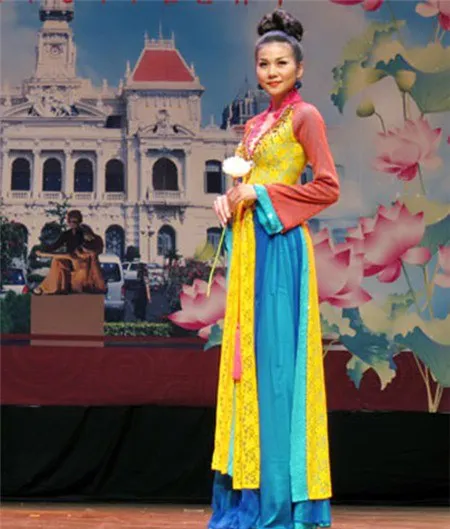
As one of the golden ages of Vietnamese feudal civilization, the Ly Dynasty established formal court dress regulations to distinguish royal officials from common citizens. Most remarkably, the Ly monarchs demonstrated the nation's independent, self-reliant spirit by issuing decrees that ended the use of imported Song Dynasty brocade (Gam Tong) for royal vestments, mandating instead that court robes be tailored from domestically woven Dai Viet silks. During this period, textile decoration rose to a sophisticated new artistic level: moving beyond simple geometric lines, artisans embroidered intricate spiral motifs and flowing cloud-hook patterns onto garments, reflecting a deep philosophical harmony between nature and human life.
The Tran Dynasty: Martial Simplicity and Cultural Independence
The defining historical hallmark of the Tran Dynasty was its three heroic victories over the invading Yuan-Mongol Empire. Because the nation stood in constant readiness to defend its sovereignty, a martial spirit of self-sacrifice permeated both military and civilian life, directly shaping the attire and aesthetic values of the entire country. Alongside the legendary "Sat That" ("Death to the Yuan Invaders") tattoo inscribed on warriors' arms, citizens of Dai Viet also tattooed the motto "Thien tu nghia quan, bao quoc an dan" ("Righteous soldiers of the Son of Heaven, defending the nation and bringing peace to the people") across their chests and abdomens, blending patriotic devotion with period aesthetics.
In daily life during the Tran era, women customarily wore the Ao Tu Than, while men often worked bare-chested or wore simple tunics paired with light, dark-colored silk trousers. Everyday colors remained practical and understated, predominantly black or dark brown, while the custom of dyeing teeth glossy black became widespread across the population. Constant vigilance against foreign invasion left little room for extravagant fashion: jewelry was kept minimal, court women avoided heavy cosmetics, and kings dressed unpretentiously when meeting the populace. Yet the Tran court proudly asserted its cultural independence by rejecting rigid Confucian color hierarchies, freely using vibrant shades of purple, pink, ultramarine blue, and emerald green across official ranks, as further explored in our characteristics archives.
The Le and Mac Dynasties: Flowing Sashes and the Crow's-Beak Scarf
During the Le and Mac dynasties, women's attire closely resembled the classic village ensemble of the 19th and 20th centuries—namely the Ao Tu Than as a common custom of women in Kinh Bac paired with the crow's-beak headscarf (khan mo qua). Fashionable women grew their hair long, wrapped it in fabric coils, parted their hair neatly down the center, and wore a long four-panel robe left open at the chest with the front flaps knotted below the waist over a wide, flowing skirt. Noblewomen and stylish townswomen added brightly colored silk sashes (that lung) that trailed gracefully down their legs, accentuating a slender, willow-like figure. Jewelry also flourished in diverse forms, including flat round bangles and earrings shaped like gourds, lotus blossoms, or delicate rings.
The Nguyen Dynasty: Folk Tradition Meets Modern Reform
Social transformations under the Nguyen Dynasty exerted a profound influence on Vietnamese clothing. While urban upper-class attire increasingly adopted modernized and Western-influenced styles, traditional folk garments—including the Ao Tu Than, the yem bodice, the khan mo qua headscarf, and the flat non quai thao palm hat—remained the living cultural soul of the nation. In the northern countryside, women wore these timeless garments both while working under sun and rain in the rice fields and while singing at spring Lim festivals, showing how women in Kinh Bac become gentle and beautiful in the Ao Tu Than custom. Meanwhile, Western dresses and modernized gowns gained popularity among young urban noblewomen, most famously Queen Nam Phuong—the French-educated consort of Emperor Bao Dai and three-time winner of the Miss Indochina title—who captivated admirers whenever she stepped out in either regal Vietnamese attire or contemporary couture.
The Peach Yem Bodice: A Romantic Emblem of Vietnamese Womanhood
Although the diamond-shaped yem bodice originated in ancient times, by the 19th century under the Nguyen Dynasty it became cherished alongside the Ao Tu Than as a signature national garment celebrating the discreet, graceful charm of Vietnamese women, a pairing examined further in Part 3 of the unique history of the Ao Tu Than. Artisans created many variations of the yem, including round-necked bodices (yem co xay), V-necked bodices (yem co xe), deeply notched swallow-wing bodices (yem canh nhan), and collared styles. Most enchanting of all was the traditional "yem deo bua", which tucked a tiny pouch of fragrant musk inside the bodice so its subtle scent would linger in the air and captivate passing admirers. While women wore humble brown or white bodices on ordinary workdays, village festivals transformed the countryside with brilliant crimson peach bodices (yem dao), rose-pink silks, and lotus-petal hues.