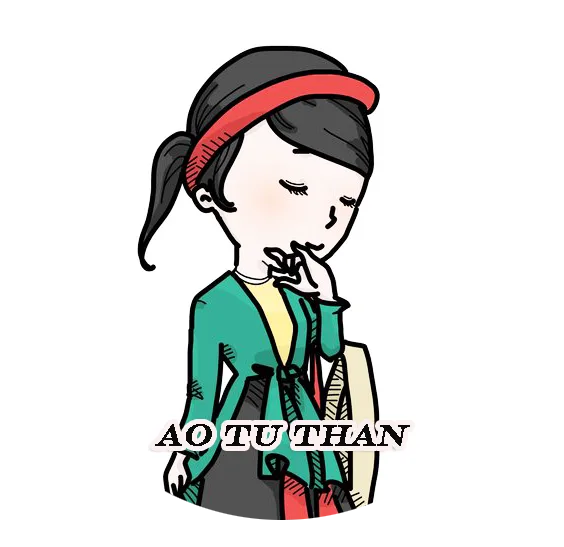
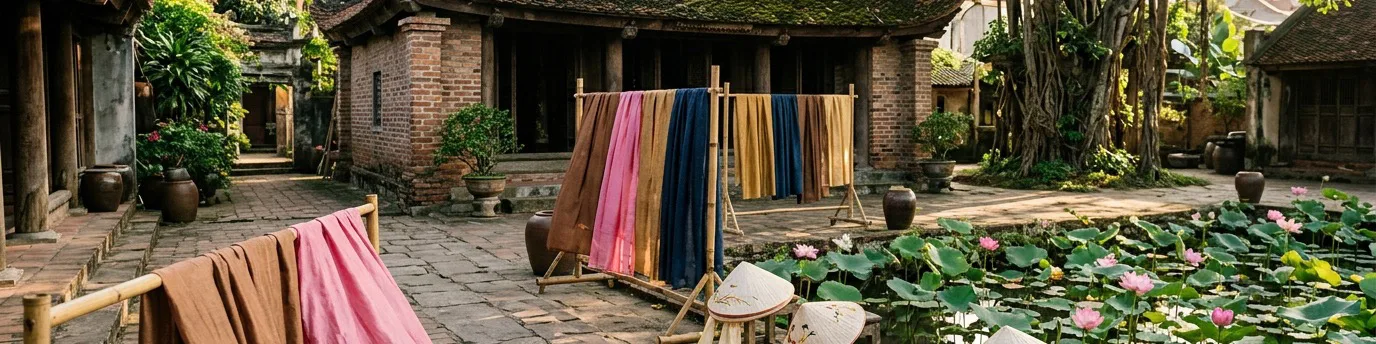
In centuries past, rudimentary handloom weaving produced narrow bolts of cloth measuring only about 35 to 40 centimeters wide. To tailor a full-length outer robe, Vietnamese artisans had to join four narrow vertical panels of fabric together—giving birth to the iconic Áo Tứ Thân (four-panel tunic). The earliest predecessor of this garment was the cross-collared robe (áo giao lĩnh), worn with its two front panels crossed loosely over the chest without knotting. Over time, as women engaged in wet-rice farming, carrying shoulder poles, and trading at village markets, they adapted the loose cross-collared robe into the split-front Ao Tu Than and the charming culture of Vietnamese people for greater agility and practical convenience.
Structure, Fabrics, and Symbolism of the Ao Tu Than
In a classic áo tứ thân, the two back panels are stitched together down the center of the spine (sống áo), with the seam edges neatly felled on the inside of the robe. The two front panels hang separate down the middle and are knotted together at the waist, allowing a woman to put on the tunic effortlessly without fumbling with small fasteners. A traditional folk verse praises this timeless silhouette: "Praise the skillful hands that sew and wear the graceful Áo Tứ Thân."
For everyday village life and farm labor, the tunic was sewn in light brown (nâu non), dark brown (nâu già), or black using durable fabrics such as coarse cotton (vải chúc bâu), raw sồi silk, or Nam Định dragon cloth (vải rồng Nam Định—a fine cotton textile woven in Sơn Nam – Nam Định and dyed rich earthy brown in the Kim Liên guild ward of old Thăng Long, now in Đống Đa District, Hanoi). For spring festivals and temple ceremonies, women tailored their tunics from sheer silk gauze (vải the), lustrous silk (lụa), or crêpe (nhiễu). Having endured across Vietnam for thousands of years, the áo tứ thân carries deep ethical meaning: its four long panels symbolize the four parents (tứ thân phụ mẫu—one's birth parents and parents-in-law), while the two front flaps tied together at the waist represent marital devotion and the close embrace of husband and wife, a heritage traced across the history of Ao Tu Than in different periods.
Classic Variations: Buong Ta, Mo Ba Mo Bay, and Ao Thay Vai
Writing about the beauty of Northern Vietnamese dress, cultural essayist Băng Sơn noted: "The áo tứ thân worn with its front flaps hanging loose or knotted at the waist; the mớ ba mớ bảy layered tunics; and the patch-shoulder tunic paired with a black skirt or purple-brown field trousers have entered folk songs and proverbs, creating a vivid portrait of poised, refined, and graceful traditional attire." Each of these classic terms describes a distinct way of wearing or tailoring the garment:
- Áo Tứ Thân Buông Tà / Thắt Vạt (Loose or Knotted Front Flaps): Leaving the two front panels untied to hang loosely (buông tà) created a soft, flowing line during leisure or festivities. When hurrying to market or working briskly, a woman tied the two front flaps together at the waist (thắt vạt) to keep the hems clear of her steps.
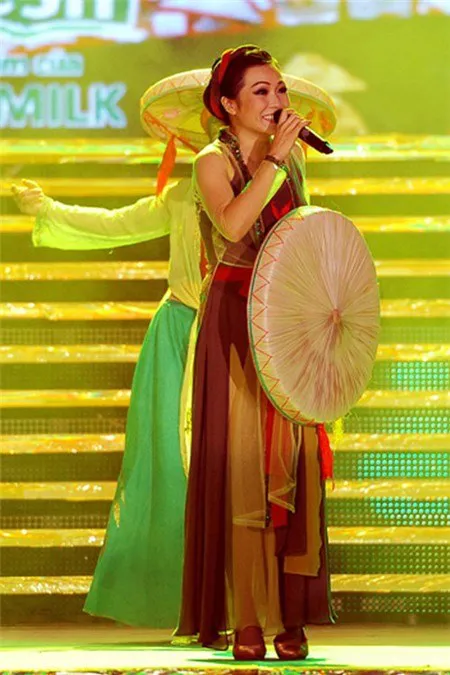
- Áo Mớ Ba, Mớ Bảy (Three-Layer and Seven-Layer Tunics): During autumn and spring temple festivals, women wore multiple tunics layered one over another—commonly three layers (mớ ba) or seven layers (mớ bảy). This layering was both a modest, graceful defense against the chill and a subtle sign of a family's prosperity. (By contrast, when working outdoors in driving rain and winter wind, Vietnamese farmers wore the áo tơi—a weatherproof rain cape woven from palm leaves with a round neck cord; once tattered, an old palm-leaf cape was hung in watermelon fields as a scarecrow to chase away birds.) In a mớ ba mớ bảy ensemble, the outermost tunic was the longest and tailored from sheer brown or black silk gauze (vải the), allowing the slightly shorter inner tunics—dyed in vibrant lemon yellow, lotus pink, and kingfisher aqua—to shine softly through the translucent outer layer.
- Áo Thay Vai (Patch-Shoulder Tunic): Also called áo nối vai or áo vá vai. Because rural women carried heavy bamboo shoulder poles day after day, the shoulder cloth of their tunics frayed and tore while the lower panels remained intact. Out of thrift, women replaced only the worn shoulder section with fresh cloth. Over time, the áo thay vai evolved into a showcase of fine needlework: women stitched eight neat rows of tiny running stitches (khâu đột tám lượt) along the rectangular shoulder patch and combined contrasting shades of brown fabric. With its staggered, neatly folded shoulder yoke, the áo thay vai became an unmistakable, 100 percent indigenous Vietnamese fashion statement.
The Ao Nam Than (Five-Panel Tunic) and Flip-Lapel Styling
Closely related to the four-panel dress is the Áo Năm Thân (five-panel tunic). While similar in cut, the front of the áo năm thân is closed rather than split down the center. Beneath the wide left front panel (vạt cả), which crosses over the chest to the right side, lies a narrower fifth inner panel (thân thứ năm or vạt con) that provides double coverage across the torso. The panels meet at a low standing collar 2 to 3 centimeters high and fasten along the right side with five buttons. When dressing for festivals, young women typically fastened only the lower four buttons, leaving the top collar button undone to reveal their slender "three-ringed neck" (cổ cao ba ngấn), complementing the Ao Tu Than and kerchief as symbols of traditional society.
Because traditional fabric bolts were only 40 centimeters wide, the sleeves featured a neat join seam just below the elbow. While the collar, sleeves, and upper bodice hugged the shoulders trimly, the panels flared generously from the ribcage down to an average hem width of 80 centimeters without waist darts. Symbolically, the four main panels represent the four parents, the fifth inner lapel represents the wearer herself, and the five side buttons embody the Five Constant Virtues (Ngũ thường): Benevolence (Nhân), Righteousness (Nghĩa), Propriety (Lễ), Wisdom (Trí), and Trustworthiness (Tín).
Because the closed five-panel tunic covered the chest completely, young maidens who wished to show a glimpse of their crimson yếm đào and white inner blouse (áo cánh) practiced the charming custom of lật vạt ("flipping the lapel"): unbuttoning the upper collar and folding the top corner of the outer front panel diagonally from the left underarm across to the throat, tucking it neatly inside. A traditional folk couplet celebrated this alluring style: "Most fragrant of all is the jasmine blossom; / Most charming of all is a five-panel tunic with its lapel folded back."
Among townswomen, five-panel tunics were also classified by the number of fabric linings sewn together: a single-layer gauze or silk robe was called áo đơn; a two-layer lined robe was called áo kép; a three-layer winter robe quilted with thin cotton batting was called áo bông or áo trần; and a four-layer silk robe was called áo mền. When a woman wore a sheer black silk gauze tunic (áo the đen) over brightly colored inner robes, the overlapping double front panels created two contrasting tonal planes—one deep and opaque where the fifth inner flap doubled the fabric, and the other softly translucent—mellowing the vivid inner colors into refined elegance, as showcased throughout our Beauty Archives.
Traditional Knotted Cloth Buttons and Metal Fasteners
The evolution of tunic fasteners also inspired poet Nguyễn Bính's famous lament: "Your tunic fastened with modern snap buttons torments my heart." Side-buttoned tunics grew widespread during the reign of Emperor Minh Mạng—around the same period the royal court established the province name Hà Nội—with women's buttons always crafted smaller and daintier than men's.
On traditional silk and cotton tunics, artisans crafted khuy tết (braided cloth buttons) from narrow strips of matching fabric. Each fastener consisted of two parallel toothpick-thin fabric stems (chân khuy) sewn to the lapel edges: one stem ended in a tightly knotted cloth bead (hạt khuy), and the opposite stem formed a loop (khuyết) to slip securely over the bead. Unlike modern metal snap buttons (khuy bấm), which popped open easily under tension and required extra metal hooks at the waist, braided cloth buttons never slipped undone. In cities, women also adorned their tunics with round glass bead buttons, amber beads, gilded brass, silver, or mother-of-pearl buttons; in rural villages, however, even when wearing a buttoned five-panel tunic, many country women simply crossed the front panel over their chest and bound it with a silk waist sash without fastening the buttons at all.