The distinctive garments worn by the Vietnamese people throughout history are collectively known as traditional Vietnamese attire (Y phuc Viet). Robes worn at formal state occasions are honored as national dress (Quoc phuc), while vestments reserved for grand imperial rites and ancestral sacrifices are termed ceremonial dress (Le phuc). How did the Ao Tu Than and the Ao Dai come to be recognized as the enduring national costumes of Vietnam? Our traditional characteristics archives trace the remarkable historical journey of these garments from antiquity to the early modern era.
Origins in the Van Lang Era and Dong Son Civilization
Even in twentieth-century archival photographs of the Nguyen imperial family, Emperor Bao Dai, Empress Nam Phuong, and the royal princes and princesses can be seen wearing formal five-panel robes that evolved directly from the older four-panel tunic tradition. To understand the roots of this national dress, however, one must look back thousands of years to the dawn of Vietnamese civilization, a heritage explored in detail in the unique history of the Ao Tu Than.
According to ancient historical annals, during the Van Lang era of the Hung Kings, the early Viet people fastened their garments on the left side (ta nham). In the first century AD, during the period of Northern domination, Prefect Nham Dien of Cuu Chan commandery ordered the local population to adopt Han-style robes fastened on the right side—a tailoring convention that remained on Vietnamese buttoned tunics in later centuries. Although no exact date marks the birth of the first Ao Tu Than, carvings on Dong Son bronze drums dating from 2,000 to 3,000 years ago reveal that early Viet ancestors progressed from primitive bark and feather coverings to woven tunics and skirts paired with feathered headdresses and braided or coiled hair.
The Legend of the Trung Sisters and Four-Panel Tailoring
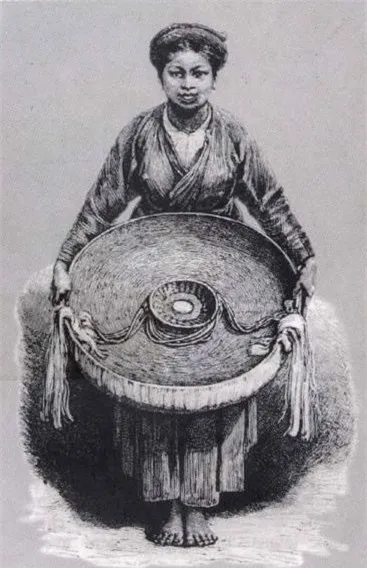
Popular legend recounts that when the Trung Sisters (Hai Ba Trung) rode war elephants to battle the Eastern Han army in the first century AD, they wore regal, flowing two-panel yellow robes beneath golden parasols. Out of deep reverence for the martyred heroines, Vietnamese women subsequently refrained from wearing two-panel tunics (ao hai than) and adopted the four-panel Ao Tu Than instead, whose four panels symbolize the four parents of a married couple (tu than phu mau). From a practical craft perspective, ancient village looms were narrow and rustic, producing cloth strips that had to be pieced together—four panels in total—to sew a full tunic:
- The Two Back Panels: Joined tightly along the center of the spine to form the main back seam (song ao), with their outer edges sewn to the front panels and turned neatly inward.
- The Two Front Panels: Left unfastened without buttons and knotted together at the waist over an inner silk bodice (yem).
- Mourning vs. Everyday Hem Etiquette: In daily life and festivals, the lower front flaps were lifted and knotted at the waist; only during deep mourning (dai tang) for one's parents or husband were the panels left untied to hang down with their raw, unhemmed fabric edges exposed.
Endurance Under Northern Rule and Lord Nguyen Phuc Khoat's 1744 Decree
After the Han general Ma Yuan suppressed the Trung Sisters' uprising, northern administrators imposed strict assimilation policies across Vietnam. Yet throughout more than a thousand years of Chinese domination, the rustic Ao Tu Than was never erased from the Vietnamese countryside, inspiring the enduring affection captured in memories of the Ao Tu Than from afar.
A pivotal turning point arrived in the eighteenth century during the reign of Lord Vo Vuong Nguyen Phuc Khoat (1739–1765) in Southern Vietnam (Dang Trong). Seeking to unify southern customs and establish cultural autonomy distinct from both the northern Trinh realm and Qing China, the Nguyen Lord issued a landmark dress reform edict in 1744. As recorded by the scholar Le Quy Don in Phu Bien Tap Luc (Miscellaneous Chronicles of the Pacified Frontier), the proclamation decreed:
"The clothing institutions of our state have long followed ancient standards. Now that our southern realm is unified within its borders, governance and customs must likewise be harmonized. Anyone still dressing in the manner of foreign guests shall reform their attire according to domestic statutes. Commoners shall tailor their garments from plain cotton or ordinary silk, while only mandarins may wear layered damask, brocade, and satin embroidered with dragons or phoenixes. For everyday attire, both men and women shall wear upright-collared tunics with short or narrow sleeves and side seams sewn closed beneath the arms, while for formal ceremonies they shall wear long-sleeved upright-collared robes of indigo, black, or white cloth according to rank."
Historical Records on the Transition to Buttoned Tunics and Trousers
The official Nguyen dynasty chronicle Dai Nam Thuc Luc Tien Bien (Veritable Records of Dai Nam) similarly notes: "Around the year 1744 in the South, Lord Vo Vuong initiated a major reform of folk costumes." Expanding on this milestone in Viet Nam Van Hoa Su Cuong (Outline History of Vietnamese Culture), the prominent historian Dao Duy Anh wrote that, as observed by the European missionary Koffler, Lord Vo Vuong ordered southern subjects to replace the northern skirt-and-bodice outfit with upright-collared, five-panel buttoned tunics worn over trousers.
Later in the nineteenth century, Emperor Minh Mang issued an imperial edict instructing women across the entire country to wear trousers rather than skirts. However, while wealthy urban families complied, rural women across Northern Vietnam steadfastly preserved their traditional woven skirts and four-panel Ao Tu Than—setting the stage for the modern transformations explored in Part 2 of Ao Tu Than in different periods.