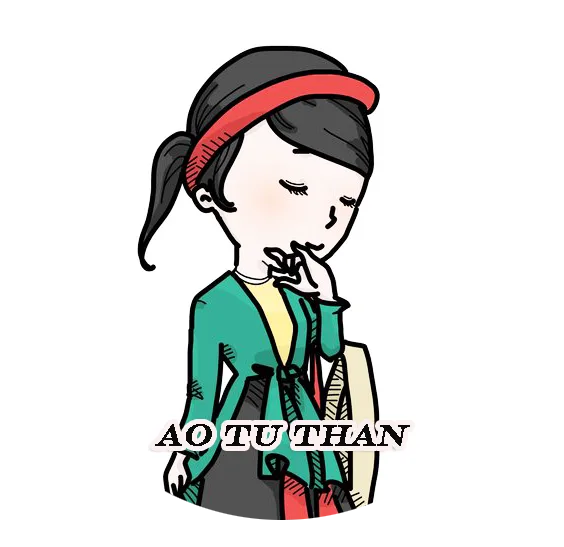
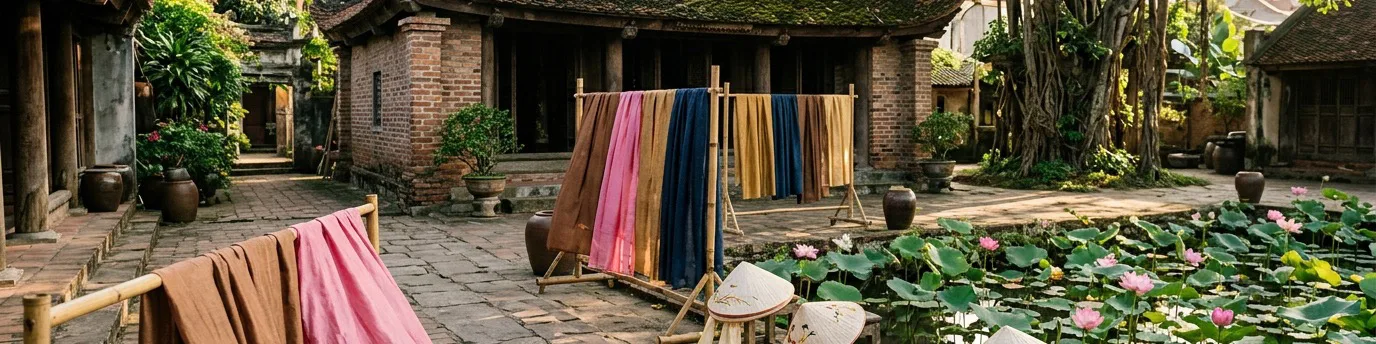
During the reign of Emperor Gia Long (1802–1819), the traditional four-panel Ao Tu Than continued to coexist with and inspire the buttoned five-panel gown (Ao Ngu Than or Ao Nam Than), which became the favored attire of aristocrats and urban townspeople across Vietnam. Readers following our traditional dress characteristics series can trace how this nineteenth-century transition bridged ancient village clothing and the modern Vietnamese Ao Dai.
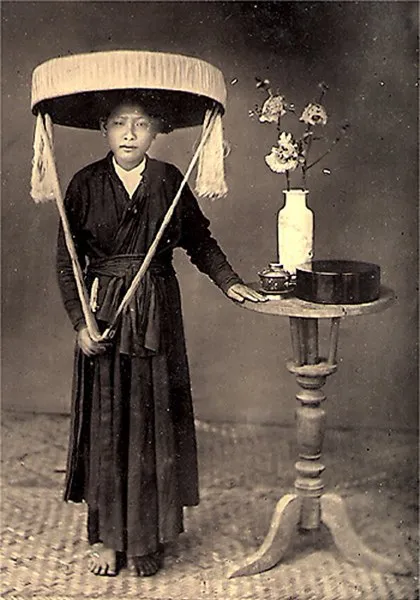
The Five-Panel Tunic and Confucian Moral Symbolism
Like the older Ao Tu Than, the nineteenth-century Ao Ngu Than was constructed from narrow hand-woven strips of silk or cotton, with two back panels joined along the spine and two outer front panels. However, on the right front side, tailors added a fifth narrower inner panel (ta con) tucked beneath the outer overlap, fastening the gown with five buttons running from the upright collar across the right shoulder to the underarm and waist. Rather than knotting the front flaps at the belly like the rustic Ao Tu Than, wearers fastened the five buttons neatly on the right side.
Every structural detail of the four-panel and five-panel tunics reflected Vietnam's indigenous worldview rather than blind imitation of foreign rule, a cultural continuity highlighted in Part 1 of the unique history of the Ao Tu Than:
- The Four Outer Panels: Represent the four parents of a married couple—one's birth parents and one's parents-in-law (tu than phu mau).
- The Fifth Inner Panel: Symbolizes the wearer themselves standing modestly beneath the protection of their elders.
- The Five Buttons (Ngu Thuong): Embody the Five Constant Virtues of Confucian ethics: Nhan (benevolence and compassion), Le (propriety and mutual respect), Nghia (righteousness), Tri (wisdom and intellect), and Tin (trustworthiness and integrity).
French Colonial Influence and the 1930s Le Mur & Le Pho Reforms
When the Hue imperial court signed the Patenôtre Treaty with France in 1884, Western cultural currents entered Vietnamese urban life alongside the spread of the Romanized Quoc Ngu script in place of classical Sino-Vietnamese characters (Chu Nho). After the French administration founded the Indochina College of Fine Arts in Hanoi in 1925, pioneering Vietnamese painters set out to modernize women's traditional attire. Bright, cheerful pastel silks began replacing the somber browns and blacks of earlier centuries, sparking lively debate in newspapers of the era.
In 1934, the artist Nguyen Cat Tuong championed the dress reform movement with an influential manifesto: "Moralists often argue that clothing exists merely to shield the body from wind, rain, cold, and sun, and that we need not concern ourselves with beauty... Yet in my view, while clothing covers the body, it also serves as a mirror reflecting the intellectual and cultural level of a nation. In any era, one need only observe how a country's people dress to understand whether they possess an artistic spirit."
Earlier in 1930, Nguyen Cat Tuong had unveiled the groundbreaking Le Mur Ao Dai (named after the French translation of his given name, Tuong, meaning "wall"). Patterned partly after Western dressmaking, the Le Mur gown featured puffed shoulders and sleeves, a lotus-leaf or scalloped collar, shoulder buttons, and a form-fitting cut paired with white silk trousers, a handbag, and a Western parasol. Soon afterward, fellow painter Le Pho refined the Le Mur design and presented an updated silhouette that won widespread acclaim at the Da Nang Fair. Blending the best qualities of the Le Mur dress with the traditional Ao Tu Than and Ao Ngu Than, Le Pho eliminated the puffed shoulders, restored a snug upright collar and right-side buttons, and tailored a sleek bodice with two flowing panels worn over white trousers and styled with a low chignon or velvet headband.
For the next three decades, the Vietnamese Ao Dai retained Le Pho's essential silhouette while experimenting subtly with collar heights, hem lengths, and waistlines, as detailed in Part 2 of the unique history of the Ao Tu Than. Women's trousers evolved in parallel: from traditional wide-waisted trousers folded over a cloth belt (quan la toa), to elastic waistbands, side buttons, and finally metal zippers (fermeture), with trouser legs widening or narrowing to match each decade's aesthetic taste.
1960s Saigon: The Raglan Ao Dai, Mini Raglan, and Experimental Cuts
In the early 1960s, the Dung Tailor Shop in Dakao, Saigon revolutionized Vietnamese dressmaking by introducing the Raglan Ao Dai worn with bias-cut trousers (quan xeo). By joining the sleeve to the bodice along a 45-degree diagonal seam from the collar to the underarm, the raglan cut eliminated the wrinkling around the shoulders and armpits that had affected earlier Le Pho-style tunics. Meanwhile, bias-cut silk trousers hugged the hips smoothly and flared into two long legs covering the ankles, gracefully concealing women's wooden clogs as they walked.
Soon after came the Mini Raglan Ao Dai, tailored with shorter, knee-length panels for students and working women in Saigon, remaining popular until April 1975. Seeking even bolder novelty, a few Saigon tailors briefly introduced a "three-panel" gown (ao ba ta) with two back flaps, a single wide front flap, a high buttoned collar, and wide bell-bottom "elephant trousers" (quan chan voi). However, this three-panel experiment quickly faded because its heavy cut clashed with the gentle, slender grace of Vietnamese women.
Traditional Hairstyles, Royal Colors, and the Spirit of the Nation
Historical sources also document the evolution of Vietnamese headwear and color etiquette, themes that resonate strongly in reflections on the Ao Tu Than from afar (Part 2):
- Hairstyles and Turbans (Khan Dong): In earlier centuries, both men and women kept long hair coiled in a bun (bui to) before French influence popularized short haircuts for men at the turn of the twentieth century. For formal ceremonies and weddings today, pre-wound turbans (khan dong) have replaced loose cloth wraps: a man's turban is traditionally wound in 5 folds forming the character Nhat or Nhan at the forehead, whereas a married woman's turban features 12 folds (symbolizing the twelve midwifery goddesses or twelve months) with two graceful loops at the nape.
- Traditional Color Hierarchy: Under the imperial court, golden yellow was reserved exclusively for the emperor and royal family; crimson red adorned sacred temples and deities; aristocrats wore patterned brocade and vibrant silks; commoners wore modest dark hues; and pure unbleached white was reserved for mourning.
- Nostalgic Icons and Living Ceremonies: Vintage photographs from the 1940s through the 1960s immortalized the poetic image of Saigon women in white silk tunics riding black Vélo-Solex mopeds with their front flap tucked behind them in the breeze, or seated in horse-drawn carriages.
With its flowing silk panels and sculpted silhouette, the traditional tunic has always satisfied the aesthetic ideal of Vietnamese women—graceful, poised, and understatedly luxurious. Nostalgic photographs from the 1940s and 1950s still evoke old Saigon with women in long tunics seated beside horse-drawn carriages, while snapshots from the 1960s capture young women in white Ao Dai riding black Vélo-Solex mopeds with the front panel tucked neatly behind the saddle as the wind lifted their silk hems.
Although some modern commentators once claimed that traditional men's robes lacked the dramatic flair of women's attire, while Western menswear may be practical for daily office life, the traditional men's five-panel tunic (ao dai khan dong) possesses a solemn dignity that no foreign suit can replace. When worn by the groom alongside the bride during wedding ceremonies, ancestral rites, and Lunar New Year celebrations, the traditional tunic and coiled turban elevate the occasion with profound cultural meaning. Together, the Ao Tu Than, the Ao Ngu Than, and the modern Ao Dai embody the national spirit and cultural essence (quoc hon quoc tuy) of the Vietnamese people—a living testament to four thousand years of civilization handed down by our ancestors.