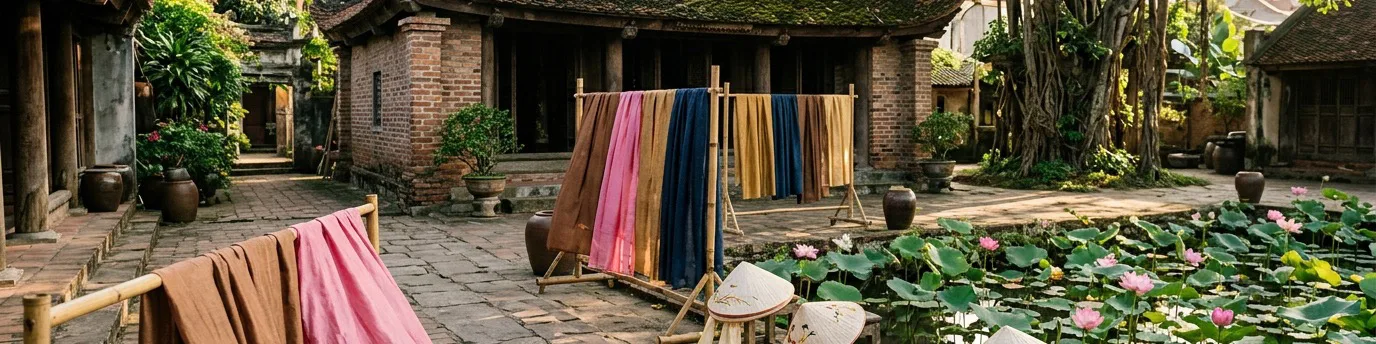
In the distant place where I live, autumn arrives almost unnoticed. The lingering days of the harvest season cast a wistful golden haze across the streets before the roadside leaves turn deep burgundy and dark crimson—shades that remind me of the rich silk panels of a traditional Ao Tu Than. Under the slanting afternoon sun, the red leaves glow briefly along the quiet avenues before retreating into a hurried sunset, while the crisp seasonal wind sweeps rustling red and yellow leaves across the pavement beneath my footsteps.
The Whisper of Wind and Flowing Silk
As I walk along the road toward the parking lot, the autumn breeze whispers past my ear like a gentle suitor, awakening a quiet joy deep within me. One hand lightly brushes my hair while the other catches my fluttering dress in the open wind. Just my dress and the breeze—that gentle tension forms a hushed joy in my heart, a sentiment echoed in our Meaning Archives.
Living far from one's homeland makes a person remember everything. We remember loved ones, our family house, the familiar old streets we crossed countless times, and childhood friends of innocent days. Whenever a wave of homesickness rolls in like an incoming tide, nostalgia rushes back all at once—from early childhood to adulthood, from summer branches teeming with young flame-tree buds (hoa phượng) to quiet streets glowing beneath overhead streetlights on a misty night. Every single image of old Saigon remains dear to me; the more I remember Saigon, the more deeply I cherish our traditional tunics, inspiring my reflection on finding the soul of the country in Ao Tu Than.
A Childhood Game of Towels and Purple Blossoms
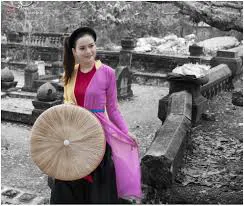
Every country in the world—even remote tribal communities—possesses its own distinctive traditional attire. For Vietnamese women, the traditional tunic, from the graceful Ao Dai to the Ao Tu Than traditional costumes of Kinh Bac women in the past, is a truly unique garment that embodies modesty, elegance, lyricism, romance, and calm poise, making every Vietnamese woman proud when wearing it. Whenever I have the chance to wear the Ao Tu Than today, I see a patch of clear blue sky from my girlhood and the vibrant springtime of my twenties.
I fondly remember my childhood when I was only six or seven years old. Every afternoon after school, watching my older female cousin glide gracefully on her Vélo Solex moped with her long tunic panels flowing in the breeze inspired me to invent my own game of dressing up and riding safely. I lined up two low iron stools about thirty centimeters high and placed the small wooden stool my mother used while picking vegetables right between them as a saddle. Then I took two bath towels, wrapping one around my chest and back like an Ao Tu Than so the two long ends trailed on the ground like flowing robe panels. Though slightly oversized, I had my own flowing gown just like anyone else.
In our backyard grew a lush pearl-string vine (cây hoa chuỗi ngọc) with year-round green leaves and clusters of tiny dark-purple flowers blooming across all four seasons. Its sweet fragrance smelled faintly of traditional toasted rice cakes (bánh khảo), inviting bees and butterflies to dance. As the youngest daughter in the house, I was dearly loved by my father; every time I played my long-dress game, he would pluck a cluster of purple blossoms and pin it into my hair so I could sit proudly on my makeshift scooter, pretending to ride as gracefully as my cousin—a story continued in Ao Tu Than from afar (part 2).