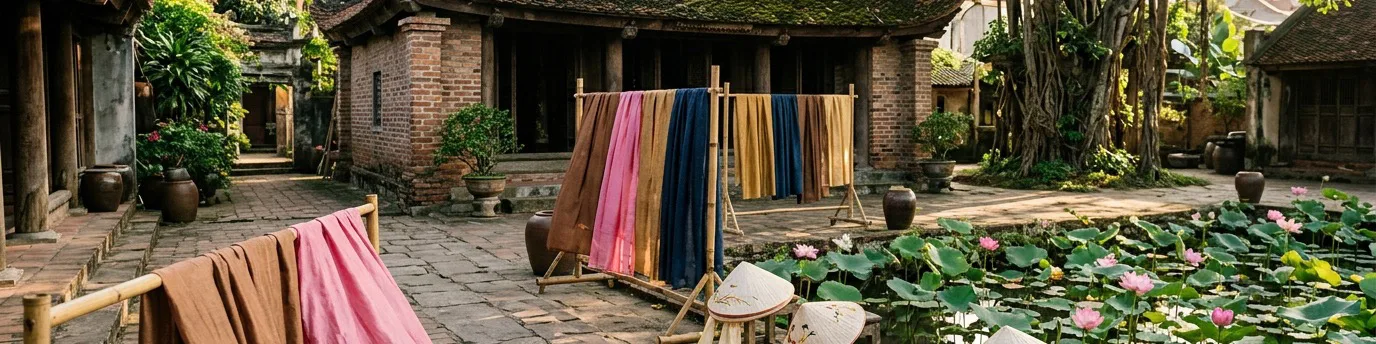
Across millennia of civilization, traditional attire has served as a living mirror of Vietnam's aesthetic sensibility, climate, and cultural resilience. Although the diamond-shaped bodice known as the áo yếm first appeared in antiquity, by the nineteenth century under the Nguyễn Dynasty it had become a cherished national garment across every social class. Embodying both modest grace and subtle feminine grace, the áo yếm was tailored in numerous neckline variations, including the round-necked yếm cổ xây, the V-notched yếm cổ xẻ, the swallow-wing yếm cổ cánh nhạn, and the collared bodice. Most enchanting of all was the yếm đeo bùa ("amulet bodice"), which held a tiny sachet of fragrant musk (xạ hương) tucked inside the neckline—a delicate secret that lingered in the memory of admirers. While everyday work bodices were dyed humble light brown (nâu non) or plain white, festive holidays saw women dress in radiant crimson (yếm đỏ), peach blossom (yếm đào), and lotus-petal magenta (yếm cánh sen).
The Flowing Grace of the Ao Tu Than
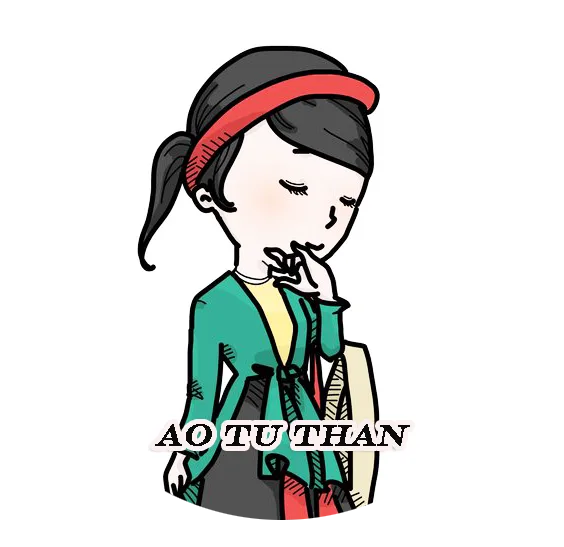
Worn over the crimson bodice is the flowing, poetic Áo Tứ Thân (four-panel tunic). This classic silhouette arose from early handloom weaving techniques that produced narrow fabric strips measuring only about 40 centimeters wide, requiring tailors to join four vertical panels together to create a full robe. Its earliest ancestor was the cross-collared tunic (áo giao lĩnh), whose two front panels crossed loosely over the chest without knotting. Later, to accommodate wet-rice agriculture, village crafts, and market trade, Vietnamese mothers and sisters adapted the garment into the split-front áo tứ thân so the front flaps could be knotted neatly at the waist for ease of movement—a rustic elegance celebrated in the country soul in Ao Tu Than.
Depending on the occasion, women wore the áo tứ thân with its front flaps flowing loosely (buông tà), tied neatly at the waist when walking to market, or layered in three or seven multicolored robes (áo mớ ba, mớ bảy) during spring and summer village festivals. Deeply rooted in Vietnamese family philosophy, the four panels of the robe symbolize the wearer's four parents (tứ thân phụ mẫu), while the two front panels knotted together represent the enduring affection and unity of husband and wife. Traditional fabrics ranged from rustic cotton (vải chúc bâu), raw sồi silk, and Nam Định dragon cloth (vải rồng Nam Định) to sheer silk gauze (vải the), smooth silk (lụa), and crêpe (nhiễu), cementing the garment's status as Ao Tu Than, a beautiful symbol of Vietnamese women.
Khan Mo Qua and Non Quai Thao: Crowning the Ensemble
Inseparable from the four-panel tunic is the classic Northern Vietnamese headdress consisting of the velvet hair roll (khăn vấn đuôi gà), the crow's-beak kerchief (khăn mỏ quạ), and the flat palm hat with its braided silk chinstrap (nón quai thao). Folding and tying a khăn mỏ quạ with a crisp central peak required deft hands and a refined eye for proportion. The peaked fold had to sit in harmony with the wearer's face: if tied too high on the crown, the forehead looked overly exposed and severe; if pulled too low over the brow, it cast a heavy shadow that darkened the features. When folded with skill, the black kerchief curved like a crescent moon around the cheeks, making a young woman's fair, rosy complexion glow against the dark cloth like a blooming pink lotus.
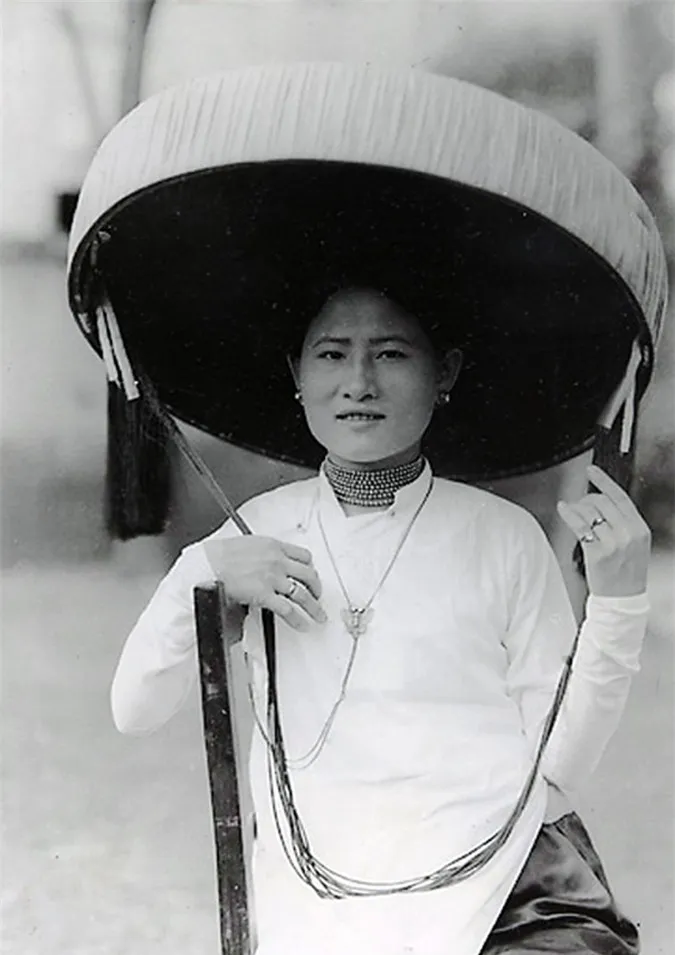
Placed atop the crow's-beak kerchief was the nón quai thao—a prized, luxurious flat palm hat reserved for holidays, temple processions, and folk singing festivals. Traditional artisans crafted three classic sizes of this ceremonial hat: nón Trường (the smallest in diameter with the lowest rim), nón Nhỡ or nón Ngang / nón Đấu (medium-sized and versatile), and nón Mười or nón Ba Tầm (the widest-brimmed and tallest-rimmed ceremonial variety).
The Ao Dai: From Dong Son Bronze Drums to Modern Elegance
No reflection on Vietnamese traditional costume is complete without the Áo Dài, the iconic long tunic recognized worldwide as a symbol of Vietnamese cultural refinement. Flowing long robes have an ancient lineage in Vietnam, with early silhouettes carved onto Đông Sơn bronze drums and prehistoric artifacts thousands of years old. According to national legend, when the Trưng Sisters (Hai Bà Trưng) mounted war elephants to lead their uprising against northern invaders in the first century AD, they wore long, two-panel golden robes beneath gilded parasols. Out of deep reverence for the two national heroines, Vietnamese women in subsequent centuries avoided wearing two-panel robes (áo hai tà) in daily life and wore the four-panel áo tứ thân instead—a fascinating historical transition explored further in Ao Tu Than in different periods (Part 2).
By the nineteenth and twentieth centuries, the áo dài had become an indispensable garment across Vietnamese society—from empresses and princesses in the imperial palace wearing court robes richly embroidered with gold thread, to urban ladies and schoolgirls wearing graceful tunics to school, work, the market, and leisurely strolls. Across the nineteenth and twentieth centuries, as Western fashion influences arrived in Vietnam, the áo dài underwent numerous creative reforms—from tailored waist-hugging cuts and the boat-neck (cổ thuyền) style popularized by Trần Lệ Xuân in the mid-twentieth century, to floor-length modern silhouettes. Yet across every historical era, the áo dài has retained its unmatched gift for exalting the slender posture and gentle, captivating poise of Vietnamese women.
Thus, across more than four thousand years of civilization and historical upheaval, Vietnam's national attire has continually evolved while overcoming every attempt at foreign assimilation. By preserving the spirit of the áo yếm, the áo tứ thân, the nón quai thao, and the áo dài—topics celebrated throughout our Meaning Archives—Vietnamese culture has crystallized its aesthetic soul into garments of enduring beauty and vitality.