The poetic image of a rural Northern Vietnamese woman dressed in an Ao Tu Than layered in "three or seven tunics" (mo ba mo bay) has long been immortalized in folk verse, standing as an enduring symbol of the virtuous and graceful women of ancient Vietnam. Within our cultural meaning archives, few garments capture the resilience and quiet artistry of the Vietnamese countryside as vividly as these heirloom robes.
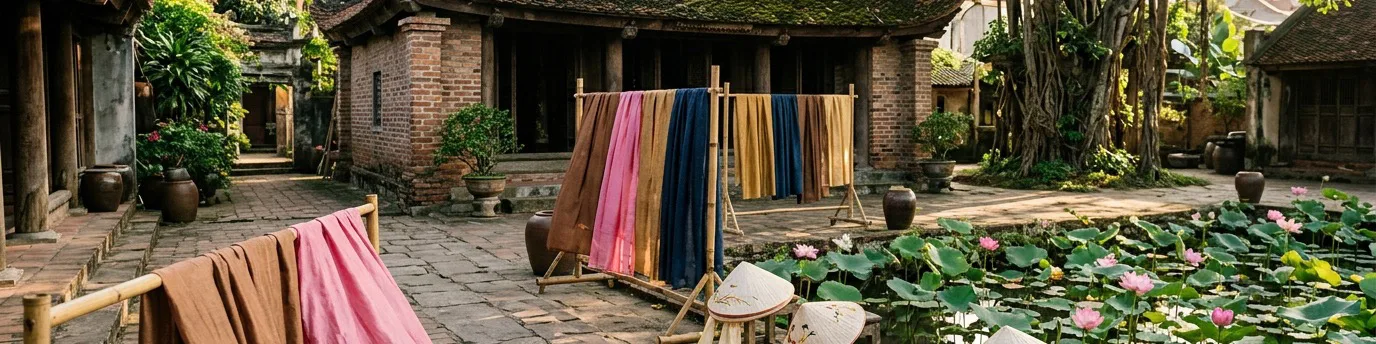
Heirloom Tunics Beneath Three-Century-Old Roofs in Duong Lam
Today, elderly women in northern villages no longer wear the four-panel tunic for daily chores, yet in many historic communities, hand-woven and naturally dyed garments from generations past are still safeguarded like family treasures. These rare heirlooms offer younger generations an authentic window into Vietnam's agrarian heritage and honor the hardworking, self-sacrificing rural mothers and grandmothers who shaped the nation's history, evoking the deep nostalgia described in reflections on the Ao Tu Than from afar.
Beneath the weathered timber roofs of ancient laterite houses dating back nearly three centuries in Mong Phu hamlet, Duong Lam commune, Son Tay (Hanoi), the village's oldest matriarchs still carefully unfold the vintage tunics that were once the pride of their youth. Paired with glossy black silk trousers (quan linh) and hand-loomed waist sashes, these garments have endured for hundreds of years. Though their natural hues have softened and faded with age, a single touch is enough to awaken memories of bustling village temple festivals and traditional wedding processions. As the elders of Mong Phu hamlet wistfully recall: "No one wears the everyday clothes of the old days anymore—with the woven wedding headscarf, the layered ceremonial tunic, the tubular waist pouch, and the flowing silk sash."
Natural Dyeing and the Art of "Dressing for Durability and Grace"
Since antiquity, farming women across the Red River Delta skillfully extracted organic dyes from wild brown yam tubers (cu nau), forest leaves, and mineral-rich pond mud to color their homespun cotton and silk fabrics. Through these patient dyeing and tailoring techniques, rural women cultivated a distinctive vestimentary culture that was at once practical, understated, and refined—highlighting the slender beauty of women in the Ao Tu Than.
Professor Tanii Yoshiko of Showa Women's University in Japan, who conducted extensive field research on the antique costumes of Duong Lam, observed that traditional Vietnamese dress went far beyond the folk adage of "eating for sustenance and dressing for durability" (an chac mac ben)—it was a true living art form:
- Sculpted Silhouette Without Buttons: Professor Tanii noted that although the four-panel tunic is cut loosely and lacks buttons, its front panels are cinched closely around the wearer's "wasp waist" (eo lung ong) with a silk sash, creating a pure, effortless elegance unique to Vietnamese women.
- Harmony with Ancient Architecture: Alongside Duong Lam's centuries-old houses, banyan trees, village gates, and brick-paved alleys, these preserved costumes complete a living portrait of an authentic Northern Vietnamese village.
Preserving Living Heritage for Future Generations
Mr. Nguyen Trong An, Deputy Head of the Management Board of the Duong Lam Ancient Village Relics, emphasized the importance of keeping this textile heritage alive: "We actively encourage villagers to preserve these antique garments so that guests visiting the ancient village can admire them during traditional holidays. During village assemblies and major family or clan ceremonies, seeing elders dressed in these historic tunics—even if the fabric is no longer brand new—carries immense educational value for children and enriches the cultural vitality of Duong Lam."
Most of the surviving antique tunics in Duong Lam belong to the village's oldest residents. According to longstanding local custom, when an elder passes away, their descendants often burn or bury these cherished personal garments with them so their ancestors may wear them in the afterlife. As explored further in part two of Ao Tu Than from afar, while sewing a modern reproduction of the Ao Tu Than today is relatively simple, the authentic century-old hand-dyed robes of Vietnam's ancient villages remain irreplaceable cultural treasures.