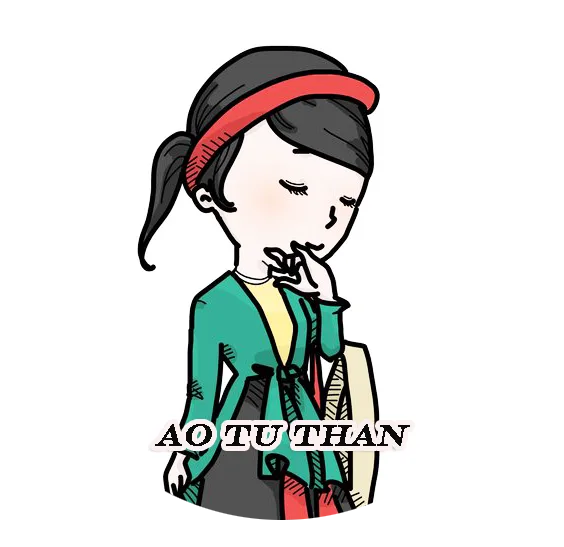
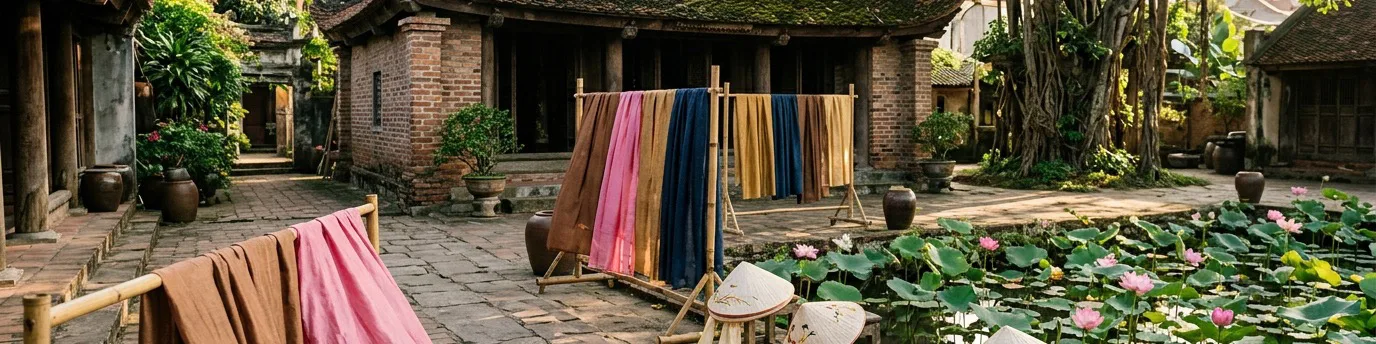
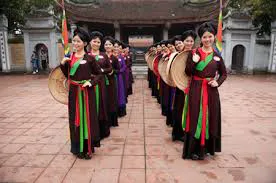
In the traditional wardrobe of Vietnamese women in centuries past, rather than modern fitted undergarments, women wore the áo yếm (traditional diamond-shaped bodice)—a modest yet deeply alluring inner garment designed to cover the chest and tailored carefully by the wearer's own hands. During warm summer days at home, women frequently wore the backless yếm on its own, leaving their shoulders, arms, and back bare to stay cool in the tropical heat. When stepping out for village festivities or market days, the yếm was worn directly beneath the flowing Ao Tu Than, a beautiful symbol of Vietnamese women.
The Ao Yem: Modesty and Poetic Allure
Although the áo yếm had been part of Vietnamese daily life since antiquity, its classic cut was standardized during the Lý Dynasty and remained largely unchanged through the nineteenth century. Cut from a square piece of cloth rotated diagonally across the chest, the bodice subtly embraced the bust while leaving the back open. The top corner was notched at the throat and fitted with two narrow fabric ties (dải yếm) fastened behind the nape of the neck. The two side corners wrapped around the ribcage to tie across the back, while the lower point tapered down over the abdomen in a graceful V-shape known as the "swallow-tail waist" (eo chim nhạn). The slender ties of the yếm inspired one of Vietnam's most famous romantic folk couplets:
"How I wish the river were only a handspan wide,
So I could stretch my yếm tie across as a bridge for you to visit."
Depending on how the top neckline corner was cut, the bodice took different names: a rounded collar cutout was called yếm cổ xây; a pointed V-shaped neckline was called yếm cổ xẻ; and a deeper, wider V-notch resembling a swallow's cleft tail was called yếm cổ cánh nhạn (swallow-wing neckline). Young maidens especially favored the yếm cổ xây, whose rounded collar band hugged the base of the throat neatly. Another enchanting variation was the "amulet bodice" (yếm đeo bùa), immortalized in the folk verse "Fifth, I love the yếm neckline adorned with a scented amulet," where a woman tucked a tiny cloth sachet filled with fragrant musk (xạ hương) inside the collar hem—a subtle, captivating charm of womanhood in bygone days.
In olden times, when meeting her sweetheart, a young woman would also tuck a freshly prepared betel quid (miếng trầu) inside the edge of her bodice to keep it warm and fragrant before offering it to her beloved. Known as "betel from the bodice edge" (trầu dải yếm), no ordinary betel leaf could rival its sentimental meaning. Women also chose the color of their yếm according to the occasion and setting:
- Light Brown (Nâu non): Worn by rural women when going to the fields, transplanting rice seedlings, or trading at the village market.
- Plain White: Worn on ordinary weekdays inside the home. (In historical Thăng Long, near the Temple of Literature – Quốc Tử Giám, lay a large lake known as Thái Hồ or Văn Hồ; along its eastern shore stood scholar pavilions built by poetry-loving benefactors so regional candidates arriving for imperial examinations had a quiet place to lodge and compose verse.)
- Festive Red and Crimson (Yếm đào, Yếm thắm, Yếm cánh sen): Worn during village festivals (vào đám), Lunar New Year (Tết), and weddings. Because red symbolized vitality, good fortune, virtue, and marital bliss in Vietnamese culture, the crimson bodice became an enduring muse in both folk songs—such as "Oh maiden in the fluttering crimson yếm"—and modern literature.
Poet Hoàng Cầm famously captured the radiance of the crimson bodice in his classic poem Across the Đuống River (Bên kia sông Đuống):
"Ever across the Đuống River,
I go in search of you;
You wear a crimson yếm thắm,
Your smile enchants the light of countless young spring hearts."
To create these festive bodices, artisans bleached white cloth and dyed it in vibrant shades ranging from peach blossom (đào), hibiscus (dâm bụt), and lotus petal (cánh sen) to ripe gấc red, plum, magenta, and vermilion. Depending on a woman's age and family means, the fabric ranged from humble woven cotton to lustrous silk, raw sồi silk, or crêpe (nhiễu). Both modest and deeply expressive, the yếm became a timeless emblem of feminine grace celebrated throughout our Beauty Archives.
Ruot Tuong Waist Pouches and Silk Sashes
Over the áo yếm and the inner panels of the tunic, Northern Vietnamese women bound their waists using two traditional accessories: the outer tubular pouch (ruột tượng) and the silk waist sash (thắt lưng or bao).
- Ruột Tượng (Tubular Waist Pouch): Sewn from black sồi or glossy lĩnh silk into a long hollow tube with fringed, twisted ends. Women placed copper coins and small valuables inside this pouch, wrapped it snugly around the waist over the back panel of the tunic, and cinched the front flaps closely to the body before tying the decorative sashes on top.
- Thắt Lưng / Bao (Silk Waist Sash): Constructed as a long silk band about one-third the width of a fabric bolt, used to fasten the skirt waistband and accentuate the wearer's slender "wasp waist" (lưng ong). Tying the sash was an art form: the long ends were knotted in front alongside the ruột tượng and left to flutter in the breeze like silk ribbons.
For spring festivals and temple ceremonies, women dyed their silk sashes in radiant traditional hues: pomegranate red (hoa lựu), peach pink (hoa đào), lotus magenta (cánh sen), bright Sophora yellow (hoa hiên), kingfisher aqua (xanh hồ thủy), sky blue (xanh da trời), green rice flake (xanh cốm), cerulean, and young banana-leaf green (xanh nõn chuối). In the ancient Northern Delta—where indigenous settlements had been called Kẻ, Chạ, and Chiềng since the era of the Hùng Kings—prosperous rural matrons and urban merchant wives also wore a xà tích at the hip. This delicate silver waist chain held miniature carved silver implements, including a tiny lime pot (ống vôi), a betel nut casket, and small tweezers, which chimed softly with every step.
Traditional Skirts (Vay) and Historical Dress Decrees
In Nguyễn Bính's famous poem Chân Quê (Country Soul), the village girl wears "black silk trousers" (quần nái đen)—a detail reflecting a major historical shift in Vietnamese dress. Since the time of the Hùng Kings, Vietnamese women had traditionally worn open-bottomed skirts (váy). Through centuries of northern domination, when foreign administrators attempted to assimilate Vietnamese customs, preserving the traditional skirt became an act of cultural resilience. In 1655, King Lê Huyền Tông issued a royal decree prohibiting northern-style trousers and requiring women to wear skirts in accordance with ancestral custom. Later, in 1744 in Đàng Trong (Southern Vietnam), Lord Nguyễn Phúc Khoát ordered southern subjects to adopt two-legged trousers and upright-collared tunics to distinguish the South from Đàng Ngoài (Tonkin), making trousers common in the South long before the North. When Emperor Minh Mạng issued a strict edict in the eighth lunar month of 1828 banning skirts outright and forcing northern women to wear trousers, villagers across the Red River Delta responded with satirical folk verses:
"In the eighth month the Emperor's edict came down,
Banning bottomless skirts and leaving the people dismayed;
If we stay home, the village market lies empty,
If we go out, must we strip off our husbands' trousers?"
True to the proverb "The Emperor's law yields to village custom" (phép vua thua lệ làng), rural women across Northern Vietnam continued to wear their cherished black skirts for generations. Another folk couplet affectionately affirmed that a woman's grace shone regardless of royal mandates: "Pretty bamboo grows in the communal courtyard; / Pretty as you are, whether in skirt or trousers, you are lovely still." You can read more about how rural women later tailored wide-legged trousers and wooden clogs in Part 4 of our traditional costume guide, as well as how layered outer tunics were constructed in Part 5 on the Ao Tu Than and Ao Nam Than.
Only during the French colonial era did urban women widely adopt white or black trousers, while village women in the Northern Delta preserved four classic varieties of traditional skirts well into the twentieth century:
- Váy Kép (Double-Layered Skirt): Sewn with two layers of cloth—a sheer, lightweight outer layer over a thicker, durable inner lining for warmth and modesty.
- Váy Guồng / Váy Quấn (Field Work Skirt): Designed so the lower hem could be gathered and tucked neatly into the waistband when wading into flooded rice paddies.
- Váy Cạp Điều (Crimson-Waistband Skirt): A full black skirt sewn with a wide crimson cloth waistband (cạp điều) at the top for festive occasions.
- Váy Cửa Võng (Valance-Hem Skirt): Tailored with a curved, pleated front hem that draped like a temple's ceremonial valance (cửa võng). A woman skilled in wearing the váy cửa võng adjusted the waistband so the back hem hung just above her heels while the front curved gently upward to brush the arch of her foot.
In traditional Vietnamese architecture, cửa võng refers to the ornate carved wooden valance suspended between the front pillars of a village communal house (đình) or temple sanctuary. Across dynasties and localities, cửa võng designs evolved from simple carved upper beams to dazzling gilded, perforated wooden draperies separated from the mezzanine. The most celebrated masterpiece is the carved valance of Đình Bảng Communal House in Bắc Ninh Province—the very imagery that inspired poet Hoàng Cầm to open his beloved poem Lá Diêu Bông with the unforgettable line: "The Đình Bảng skirt drapes softly like a temple valance."