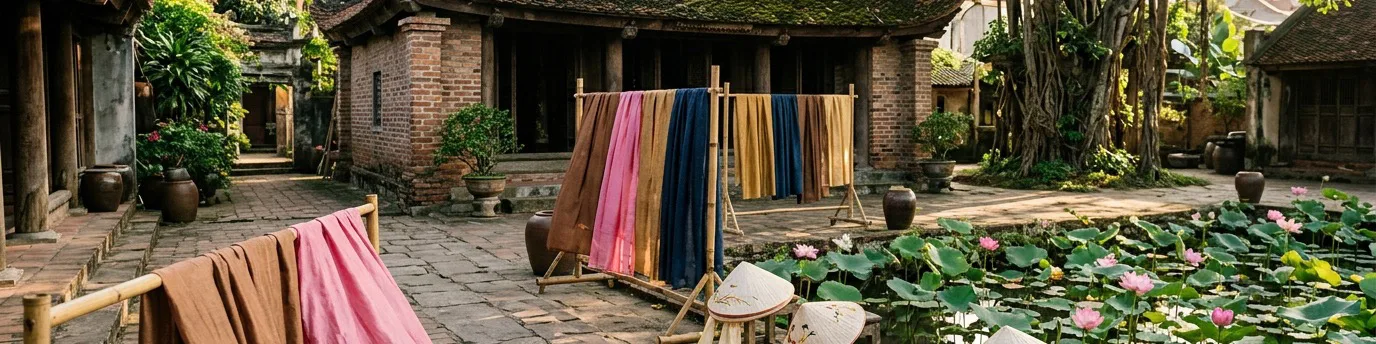
Traveling to the ancient land of Kinh Bac—with its winding river dikes, romantic arched bridges, and whispering green bamboo groves—brings visitors to the cherished cradle of Quan Ho folk singing, a lyrical tradition deeply etched into the Vietnamese soul. Yet few visitors realize that to create the enchanting, poetic atmosphere that captivates every listener, the Ao Tu Than stands as an indispensable cultural hallmark in the lives and customs of the Quan Ho singers.
Stepping Back in Time to the Cradle of Kinh Bac Courtship Singing
It is no coincidence that whenever the Lien Chi (female Quan Ho singers) intone their heartfelt farewell verses, their graceful silhouettes linger in the hearts of their Lien Anh (male singing partners) and everyone gathered to listen. Nor is it any wonder that travelers from distant provinces leave the spring Lim Festival with a solemn promise to return the following season in search of the flowing Ao Tu Than. In cultural history, certain art forms are born as natural soulmates, flourishing only when paired together. Quan Ho folk singing and the four-part tunic share just such a bond, elevating one another until Bac Ninh Quan Ho folk songs were officially inscribed by UNESCO as an Intangible Cultural Heritage of Humanity in 2009—a proud milestone within Vietnam's 4,000-year history of traditional costume.
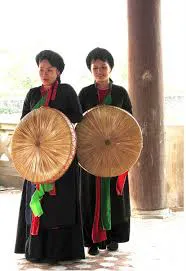
During a fortunate visit to Bac Ninh City to meet and interview veteran folk artisan Nguyen Thi Ban, I heard a memorable reflection on the bond between song and dress. She explained: "For anyone following in the footsteps of ancient Quan Ho singing, if a Lien Chi does not sew or acquire for herself a proper set of Ao Tu Than—today affectionately called the Ao Quan Ho—complete with a lotus-pink Yem bodice and a peach-silk waistband, she is considered to be merely standing outside the doorway rather than truly belonging to the storied folk tradition of the Northern delta."
Those heartfelt words from one of the respected village elders of ancient Quan Ho inspired me to journey repeatedly across the riverbank villages of Kinh Bac—a land of poetic courtship—to uncover the deeper meaning behind their attire, a subject we explore further in Part 2 of our journey into Ao Tu Than and Quan Ho songs. Traditional village singing, known locally as Choi Quan Ho Co, is an antiphonal vocal exchange between Lien Anh (male singers) and Lien Chi (female singers). Historically performed purely acapella without musical instruments or stage announcements, the songs served as a refined medium of emotional kinship and scholarly courtesy. Under time-honored village covenants, paired male and female singing groups who entered into sworn brotherhood and sisterhood (ket cha) vowed never to marry one another, keeping their lyrical devotion pure, platonic, and lifelong. Today, as Quan Ho is also performed on stage to share emotional connection with wider audiences, the elegance of the singers' traditional wardrobe receives even greater care, as celebrated across our traditional beauty archives.
Devotion Woven into Every Panel of the Ao Tu Than
Artisan Nguyen Thi Ban also recalled oral legends passed down by village elders regarding the origins of the garment. According to folk memory, when the heroic Trung Sisters (Hai Ba Trung) rode into battle in the first century, they wore long yellow tunics split at the front for ease of movement. In later generations, Vietnamese women honored the two national heroines by adopting the four-part split-front tunic, respectfully avoiding imperial yellow and tying the two front panels neatly at the waist, an evolution detailed in Part 2 of our series on traditional Vietnamese women's costumes. Although historians have yet to reach a single definitive conclusion on the exact birth date of the Ao Tu Than or the multi-layered Ao Mo Ba Mo Bay (three-layer and seven-layer tunics) of Quan Ho, the people of Kinh Bac remain forever convinced that this extraordinary attire was born specifically to grace their homeland songs.