After all, fashion is my lifelong passion, and I remain strict with myself so that I can invent distinctive, memorable designs that capture timeless elegance—the true harmony of Truth, Goodness, and Beauty (Chân – Thiện – Mỹ). Continuing our feature in the cultural fashion news archives, designer Xuân Thu reveals the making of her landmark solo show.
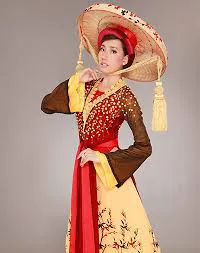
An Exclusive Áo Tứ Thân Collection Adorned with Brown Pottery Motifs
Reporter: Looking ahead, you will launch your solo fashion show titled "Duyên" at 7:30 PM on November 20 at the Hilton Hotel in Hanoi and unveil a Kinh Bắc four-panel dress collection featuring brown ceramic motifs. Why did you wait until now to stage a solo show of your own?
Designer Xuân Thu: Over the years, I have collaborated with many designers on joint runway programs. Now that I have sufficient financial resources, I decided to stage my own independent production, funded entirely by myself and my family. Although several sponsors offered grant proposals, I wanted full creative freedom to produce a show of my own. For me, this evening holds special significance—not merely celebrating fifteen years in art, but unveiling a unique heritage collection unlike any other.
Reporter: Could you introduce more details about the inspiration behind this collection?
Designer Xuân Thu: Through the years, I have always thought about how to honor the beauty of Vietnamese women. Because the áo dài is already so familiar, I wanted to create a Kinh Bắc Áo tứ thân collection. These garments represent the original dress culture of Vietnamese women—remarkably graceful with their brightly colored yếm bodices, flowing inner blouses, and sheer outer robes split into two sides and four panels, a tradition also explored in part two of our guide to traditional costumes associated with the Áo tứ thân. In village communal houses or Vietnamese museums, we frequently encounter statues of women dressed in the áo tứ thân.
At the same time, I spent years studying Vietnamese brown-patterned ceramics (gốm hoa nâu) from the eleventh to fifteenth centuries. Their rustic brown glazes and floral motifs feel deeply intimate because they were created by Vietnamese artisans during the Lý and Trần dynasties, embodying authentic national culture without foreign imitation. That inspired me to ask: why not unite these two Vietnamese traditions into a single collection? Previously, many designers have created creative shirts and modern outfits based on the Áo tứ thân, and others have explored blue-and-white porcelain (gốm hoa lam), but when it comes to combining the four-panel dress with brown-textured ceramics, I can confirm that I am the first.
Overcoming Textile Challenges from Sketch to Runway
From initial sketches to finished garments, the process proved extremely difficult. How do you stitch together two roots of Vietnamese culture without turning them into an awkward hybrid? How do you place the ceramic motifs onto the panels so they blend with the layout of the dress and allow the audience to feel its beauty? Drawing a single motif is simple, but crafting dozens of looks that tell a designer’s story is far harder.
Once the paper manuscripts were finished, selecting costume materials posed another challenge. I chose traditional textiles such as silk, chiffon, organza, and taffeta to match the outfits. Yet when draped on the mannequin, several fabrics and colors did not match the manuscript or suit the spirit of Duyên. Sketching on the dress form and redrawing ten times over, discarding torn or unsatisfactory cloth, the final samples evolved significantly from the original drawings. Never before has a collection been so costly or required me to give up so many fabrics. Still, I remained determined because I always strive to celebrate Vietnamese women and affirm their cultural identity in the world, much like the pride seen when singer Phi Nhung wears the Áo tứ thân and nón quai thao on stage. Only when slipping on these robes can wearers truly feel everything Xuân Thu wishes to convey.
Runway Cast and the Milestone of "Duyên"
Reporter: Since your work honors traditional Vietnamese women, why did you choose Trúc Diễm—known for her modern, somewhat Western beauty—as the vedette for this collection?
Designer Xuân Thu: I believe Trúc Diễm has a slender figure representing many modern Vietnamese women, which is why I chose her as vedette. I want my clothes to carry high applicability from the stage into everyday life so that any Vietnamese woman can wear them. Alongside Trúc Diễm, the show will feature Áo Dài titleholder Phan Thị Kim Ngân, Miss Vietnam Top 10 finalist Hồng Nhung, and models from Vietnam’s Next Top Model. Together they will showcase 50 outfits: more than 20 couture sets featuring brown ceramic floral motifs, followed by contemporary wearable designs carrying the same four-panel spirit, and finally a nostalgic segment of quilted cotton jackets (áo bông chần) like those our mothers and grandmothers wore in decades past.
For one minute of glory on the catwalk, a designer must pour out sweat, sleepless nights of concern, and quiet tears of happiness. To me, Duyên is truly a landmark and a catalyst for the growth of my brand—marking my maturity in crafting haute couture that carries unmistakable Vietnamese cultural soul.