Blending gentle fluidity with crisp contemporary tailoring, a distinctive new shirt collection has captured attention by reimagining the iconic silhouette of the Ao Tu Than, Northern Vietnam's traditional four-part dress. By translating the signature layered construction and color harmony of the Ao Tu Than into an everyday button-down shirt, the design achieves an effortless balance between classic heritage and expressive modern style.
Bridging Ancient Heritage and Contemporary Wardrobe Staples
At first mention, the traditional Ao Tu Than and the modern collared shirt seem to belong to entirely separate worlds. They differ in cut, color palette, and social setting: one is an ancient, gracefully flowing garment deeply associated with traditional Vietnamese femininity, while the other is a structured, versatile staple worn across genders in modern daily life. Just as Hoang My chose the Ao Tu Than as her national costume to bring Vietnamese heritage onto the international stage, contemporary young creatives are finding fresh ways to weave traditional silhouettes into everyday fashion.
What makes this stylized shirt particularly remarkable is that it was conceived and handcrafted by a young designer of Vietnamese heritage living in Europe. Trinh Thuy Linh—known creatively as Lini—moved to Germany with her family as a child and currently studies fashion design at the University of Applied Sciences and Arts in Hanover, Germany. Although she does not live in Vietnam every day, she continuously breathes the Vietnamese spirit into each of her garments, much like the cultural pride seen in our latest cultural news covering Vietnamese heritage abroad.
Reflecting on her inspiration, Linh explained: "In Vietnam, many young people love to wear Western-style clothes like foreigners. I am the exact opposite. I have always loved the traditional costumes of Vietnam. Even though my family and I have lived abroad for many years, we regularly take part in cultural festivals and winter gatherings of the Vietnamese community here in Germany."
For Linh, these community gatherings are cherished opportunities to speak her native language and wear traditional Vietnamese attire. "Because my mother is an enthusiastic folk singer, my sister and I often dress in traditional costumes to perform backup dances alongside her on stage," she added.
"Each time we prepare for a performance, I spend hours dressing in traditional layers, and before I knew it, the silhouette of a shirt based on the Ao Tu Than began taking shape in my design sketches. I introduced subtle modern innovations while striving to preserve the authentic soul of the traditional dress."
Preserving the Signature Colors and Drape of the Ao Tu Than
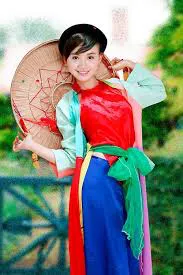
Long before the modern Ao Dai became the universal emblem of Vietnamese women, the Ao Tu Than stood as the purest expression of Northern Vietnamese grace, accented by two contrasting or adjacent inner and outer color layers. As explored in our study of traditional Vietnamese women's costumes associated with the Ao Tu Than, the four flowing panels of the tunic were designed to flatter a woman's natural curves when tied over a crimson yem bodice and a silk waistband.
When adapting these historic elements into a contemporary shirt, Linh carefully retained the defining visual traits of the Ao Tu Than. She selected soft natural silk to soften the rigid lines typical of tailored shirts, and paired layered front panels in classic folk colors—such as turquoise, golden "chicken-fat" yellow, and lotus pink—creating striking contrast without ever feeling visually overwhelming. While stage artists often celebrate the full folkloric ensemble, as seen when Phi Nhung wore the Ao Tu Than with a Non Quai Thao hat on television, Linh wanted her creation to transition seamlessly into daily urban life.
"At first glance, a shirt might look simple, but drafting this pattern took a great deal of time because I wanted to retain the gentle drape of the four-part tunic without losing the crisp, dynamic character of a classic shirt," Linh shared. "I felt happiest when my international classmates and professors in Germany praised the collection for its traditional Vietnamese wings and layered collar."
Initially, the piece began as a university design exercise that Linh photographed and shared on social media. To her surprise, many friends and fashion enthusiasts fell in love with the silhouette and inquired about ordering custom pieces. Since then, the student designer has crafted and sold dozens of shirts in multiple color combinations. While many Vietnamese designers have unveiled stylized traditional costumes for runway demonstrations with limited everyday practicality, Thuy Linh remains committed to creating wearable, innovative garments that introduce the beauty of Vietnamese heritage to young people everywhere.